

Rose Gautam, Antalya, Türkiye
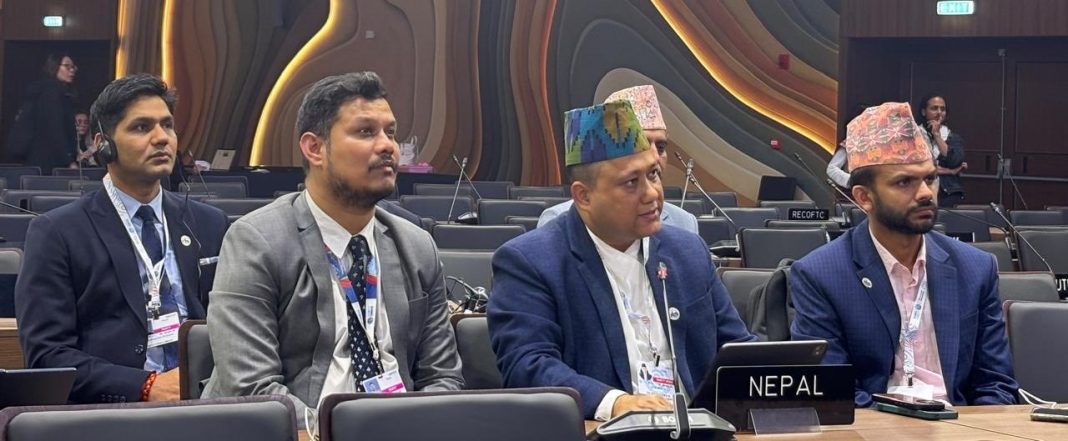
Nepal has urged the international community to scale up climate adaptation financing and make funds more accessible to help mountain regions withstand the growing threats of climate change, with Foreign Minister Shisir Khanal making an impassioned appeal at a high-level event on the sidelines of the 31st Conference of the Parties (COP31) to the United Nations Framework Convention on Climate Change in Antalya, Türkiye.
The event, titled “Strengthening Mountain Resilience through Adaptation Finance,” was jointly hosted by a coalition of mountain countries—Nepal, Bhutan and Kyrgyzstan—in partnership with the International Centre for Integrated Mountain Development (ICIMOD) and the JOY Environment Network. It served as a platform for Nepal to press its case that the accelerating climate crisis in mountain regions demands sustained, dedicated attention within the global climate framework.
Drawing attention to the devastating August 26 Bhotekoshi flood, Minister Khanal highlighted the economic, physical and human toll of climate-induced disasters in Nepal. He stressed that stronger regional and international cooperation was essential to protect vulnerable mountain communities from increasingly severe climate impacts.
Noting that nearly one-third of the world’s population depends directly on mountain ecosystems for their livelihoods and well-being, the Minister called for mountain resilience to feature more prominently on the global climate change agenda. He pressed for increasing the volume and mobilization of predictable, easily accessible climate finance to support adaptation efforts, and urged the international community to maintain the possibility of limiting global temperature rise to 1.5 degrees Celsius.
The Bhotekoshi Disaster: A “Himalayan Tsunami”
Opening his address to the COP31 plenary, Khanal reminded world leaders that Nepal was still grieving the devastating Himalayan disaster of August 26.
“I come here from a nation still in grief. On 26 August, mountain collapse unleashed what we have called a Himalayan Tsunami,” he said.
According to the minister, more than 1,400 people lost their lives, while over 5,000 remained missing. Critical infrastructure was swept away within minutes, and rebuilding would cost approximately one-tenth of Nepal’s entire economy. “Science confirms climate change had a role,” he said, linking the disaster to the wider consequences of global warming in the Himalayas. Khanal also noted that Nepal had experienced three major disasters between August and October, underscoring the country’s growing exposure to climate-related hazards.
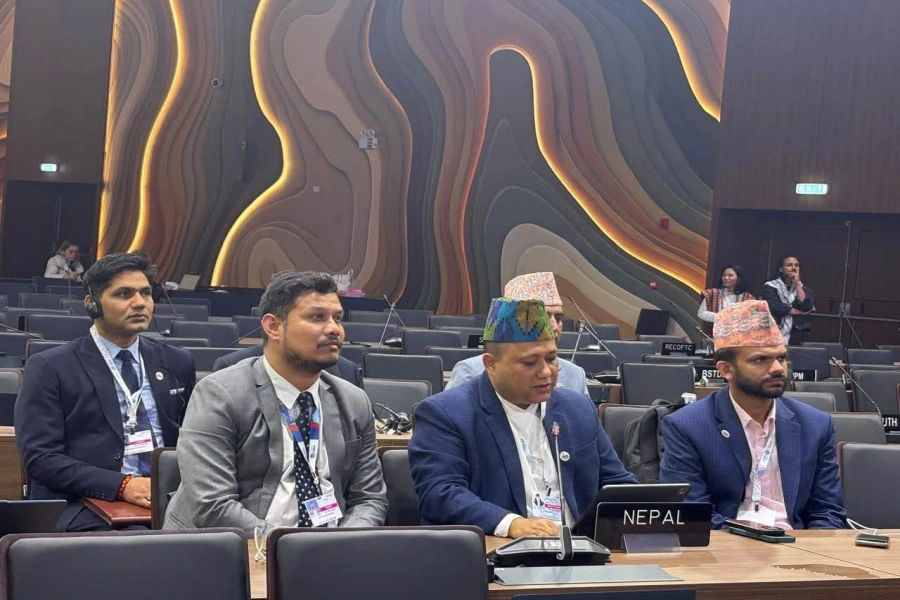
The minister emphasised the stark contradiction between Nepal’s negligible contribution to global greenhouse gas emissions and the disproportionate climate impacts it faces. He pointed out that the Himalayas sustain the lives and livelihoods of nearly one-third of humanity, yet are melting at an alarming rate. “We come here seeking climate justice,” he declared.
A Diplomatic Push and Its Limits
Nepal’s formal diplomatic effort was set out in a joint five-page submission by the Government of Nepal and the Royal Government of Bhutan, dated October 28 and formally transmitted by Agriculture, Forests and Environment Minister Gita Chaudhary on October 29. Titled “1.5°C Warming in Mountains,” the proposed supplementary provisional agenda item outlined four actions for consideration by COP31.
The two countries called for a scientific assessment of the impacts and risks of 1.5°C warming and potential temperature overshoot in mountain regions; institutionalisation of an annual high-level dialogue on mountains and climate change; initiation of a process toward establishing a dedicated UNFCCC Work Programme on Mountain Ecosystems; and integration of mountain-specific priorities into adaptation frameworks, climate finance arrangements and loss-and-damage mechanisms.
The submission cited Article 4.8 of the UN Framework Convention on Climate Change, which recognises the specific needs and vulnerabilities of countries with fragile ecosystems, including mountain ecosystems. It also referred to the Sagarmatha Sambaad held in Kathmandu in May 2025 and its Sagarmatha Call for Action as an important political foundation for a stronger international mountain agenda.
The proposal highlighted the importance of mountain ecosystems to downstream populations, noting that rivers originating in mountain regions provide water to more than two billion people in Asia and beyond. It specifically cited Nepal’s Bhotekoshi disaster, alongside the Melamchi floods of 2021, the Kathmandu and Thame events of 2024 and the Ilam disaster of 2025, as examples of escalating climate-related loss and damage in the Hindu Kush Himalaya. The submission also argued that mountain vulnerabilities remain inadequately addressed in existing international climate mechanisms, particularly in adaptation finance, loss and damage, and systematic climate monitoring.
Despite these efforts, Nepal’s diplomatic push to secure a dedicated place for the Himalayan climate crisis in global climate negotiations fell short at COP31. The two proposed mountain-related agenda items were not included in the agenda adopted at the opening of the conference on Monday. Instead, COP31 President Murat Kurum announced that the presidency would hold consultations on mountains and climate change, while the issue would also be taken up through research dialogues at the UN climate meetings in Bonn in 2027 and 2028. The outcomes of the dialogues will be reported to COP32 and COP33, respectively. The presidency has also committed to bringing the issue into discussions at the COP31 Leaders’ Summit.
“Promises into Action”
Addressing the opening plenary, Foreign Minister Khanal said the progress made through negotiations fell short of Nepal’s expectations despite constructive engagement by the presidencies and participating countries.
“We ask the presidencies to ensure that the cover decision and Presidency consultations on ‘matters relating to mountains and climate change’ reflect three priorities: the urgency of 1.5°C for mountains, a dedicated work programme on mountains and climate change, and integration of financial and adaptation frameworks ensuring mountain-specific indicators in the Global Goal on Adaptation (GGA) and the New Collective Quantified Goal on Climate Finance (NCQG),” Khanal said.
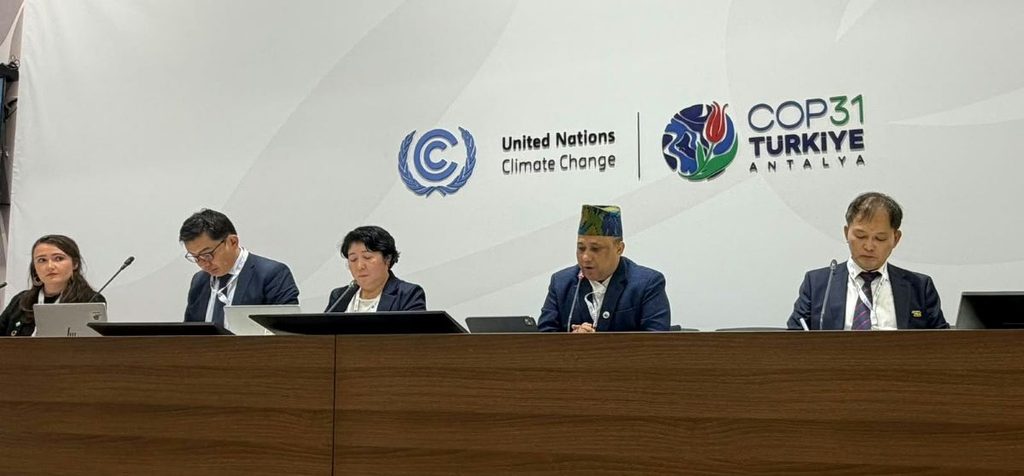
Questioning why the international community finds it difficult to recognise an issue affecting around 27 percent of the world’s geographical area and 15 percent of its population as a critical global climate concern, Khanal urged countries to demonstrate solidarity with mountain communities. “After the disaster, we received an outpouring of sympathy. This is the time to put sympathy into the system. Promises into Action,” he told the plenary.
Nepal’s Own Climate Commitments
Khanal’s address also sought to highlight Nepal’s own climate actions despite its limited contribution to global emissions. He said around half of Nepal’s land was covered by community-conserved forests, its energy system was powered by hydropower, and more than 70 percent of newly purchased consumer vehicles were electric. He invoked Nepal’s “Sagarmatha to the Sea” perspective, stressing that changing climate conditions were transforming people’s lives, landscapes and future prospects.
For Nepal, the mountain agenda is closely connected with its broader demand for climate justice, including predictable and grant-based adaptation finance, accessible loss-and-damage support and international cooperation to protect vulnerable communities.
What Comes Next
The presidency’s decision to pursue consultations and research dialogues offers an opportunity to keep mountain issues within the UN climate process. However, it does not yet meet Nepal’s demand for a dedicated work programme or an institutionalised annual high-level dialogue. The challenge for Nepal and other mountain countries will now be to ensure that the proposed consultations lead to concrete decisions rather than another round of discussions without a clear mechanism for addressing the growing climate risks facing mountain regions.
As Khanal’s plea echoed through the plenary halls of Antalya, the question remains whether the international community will translate its expressions of sympathy into the systemic action that mountain nations argue is urgently needed—before the next “Himalayan Tsunami” strikes.