
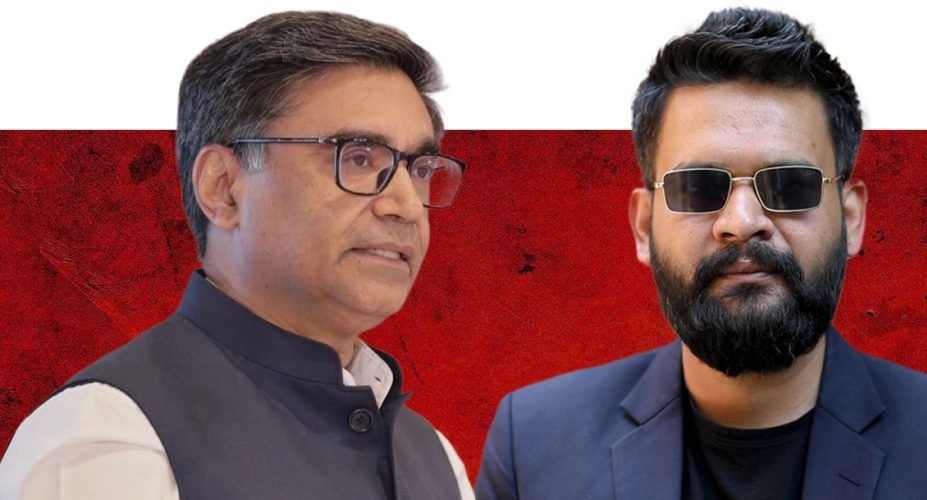

The courtyard of Singha Durbar, Nepal’s seat of power, witnessed a quietly consequential moment on Thursday morning. Indian Foreign Secretary Vikram Misri, wrapping up a two-day official visit, sat down with Prime Minister Balendra Shah — a courtesy call that carried the weight of expectation far beyond its formal billing.
According to the Prime Minister’s Secretariat, the two men discussed further strengthening and expanding the historical bilateral relations between Nepal and India. Misri expressed the Indian government’s continued commitment to Nepal’s development and prosperity. The conversations, officials said, touched on connectivity, trade, cultural ties and a range of mutual interests — all described as “positive.”
But beneath the diplomatic pleasantries lay a more urgent purpose: rescuing a high-level dialogue that had lost its rhythm, and laying the groundwork for what both capitals hope will be a landmark prime ministerial visit to New Delhi later this month.
The visit was, by any measure, an exercise in re-energization. Recent months had seen political and diplomatic contacts between the two neighbours slow to a crawl — a drift compounded by the postponement of Misri’s originally scheduled May trip amid differences over protocol and renewed friction over the Lipulekh boundary dispute, after Nepal objected to India’s route for the Kailash Mansarovar pilgrimage through the contested mountain pass.
Misri’s arrival in Kathmandu on Wednesday, therefore, was less a routine engagement than a deliberate attempt to restart the conversation at the highest levels. Since landing, he has maintained a punishing schedule of high-level meetings — sitting down with Foreign Minister Shishir Khanal, Finance Minister Swarnim Wagle, Energy Minister Viraj Bhakta Shrestha and Physical Infrastructure and Transport Minister Sunil Lamsal — each encounter calibrated to a different strand of the bilateral relationship.
With Foreign Minister Khanal, discussions centred on expanding the multifaceted partnership. With Finance Minister Wagle, the focus was economic partnership, India-assisted development projects and fresh possibilities for economic cooperation. With the energy and infrastructure ministers, conversations turned to water resources, Indian investment plans, and making connectivity projects effective. Both sides, officials said, expressed interest in enhancing cooperation across air, rail and road networks, border bridges, petroleum pipelines, power transmission lines and digital connectivity.
Yet the centrepiece of the visit was always the proposed trip by Prime Minister Shah to India — his first bilateral visit since taking office. Indian Prime Minister Narendra Modi has extended the invitation, and while no official dates have been announced by either government, the visit is widely expected to take place from November 22 to 24.
According to diplomatic officials, Wednesday’s delegation-level talks between Foreign Secretary Amrit Bahadur Rai and Misri went well beyond a routine review of relations. The two sides did their homework on the agenda for Shah’s visit — what might be achieved, and how long-standing issues could be elevated to the political level.
Border disputes, additional air routes for Nepal, the growing trade deficit, transit facilities and accelerating implementation of the Pancheshwar multi-purpose project are all likely to feature. So too are the problems facing hydropower projects run with Indian investment and the progress of Indian-assisted projects under construction in Nepal. Officials acknowledged that more coordination between the concerned ministries is needed to finalize the topics to be presented during the prime ministerial visit.
The visit also carried a humanitarian dimension. In his talks with Foreign Secretary Rai, Misri highlighted the massive damage inflicted on Nepal’s infrastructure by the Bhotekoshi floods and said India was ready to assist in reconstruction and rehabilitation.
Nepal is set to propose a financial assistance package exceeding one billion dollars — including concessional loans, $500 million in grants, and an additional $500 million for reconstruction and rehabilitation. While the Indian side responded positively and indicated readiness to discuss specific project proposals, officials suggested the final agreement would likely be sealed during the Prime Minister’s visit, with Nepal preparing a project proposal to present to India.
The broader significance of the visit lies in the timing. Nepal and India share an open border and deep ties of trade, transit, energy, security and people-to-people contact. But in recent times, political-level dialogue on some bilateral issues has failed to gain momentum. Border disputes, trade imbalances and implementation problems in development projects remain unresolved. Nepal, for its part, needs to make its priorities clear on easier market access for Nepali products, more air entry routes, energy trade and large infrastructure projects.
Sudhakar Dalela, proposed by India as its new ambassador to Nepal, arrived in Kathmandu on Tuesday — a further signal that both sides are staffing up for a period of intensified engagement.
In this backdrop, Misri’s visit is seen as an attempt to lay the groundwork for the next prime ministerial encounter. The challenge before Nepal is to use Shah’s visit as an opportunity for concrete progress on long-raised issues, rather than limiting it to formal meetings and commitments. Nepal will convey its desire to take the relationship forward on the basis of mutual respect, sovereign equality and mutual benefit.
For India, the opportunity is equally clear: to make its development partnership more effective by building a relationship of trust with Nepal’s new political leadership. If the warmth of this week’s meetings translates into substance later this month, Misri’s Kathmandu mission may well be remembered as the moment the dialogue restarted.