
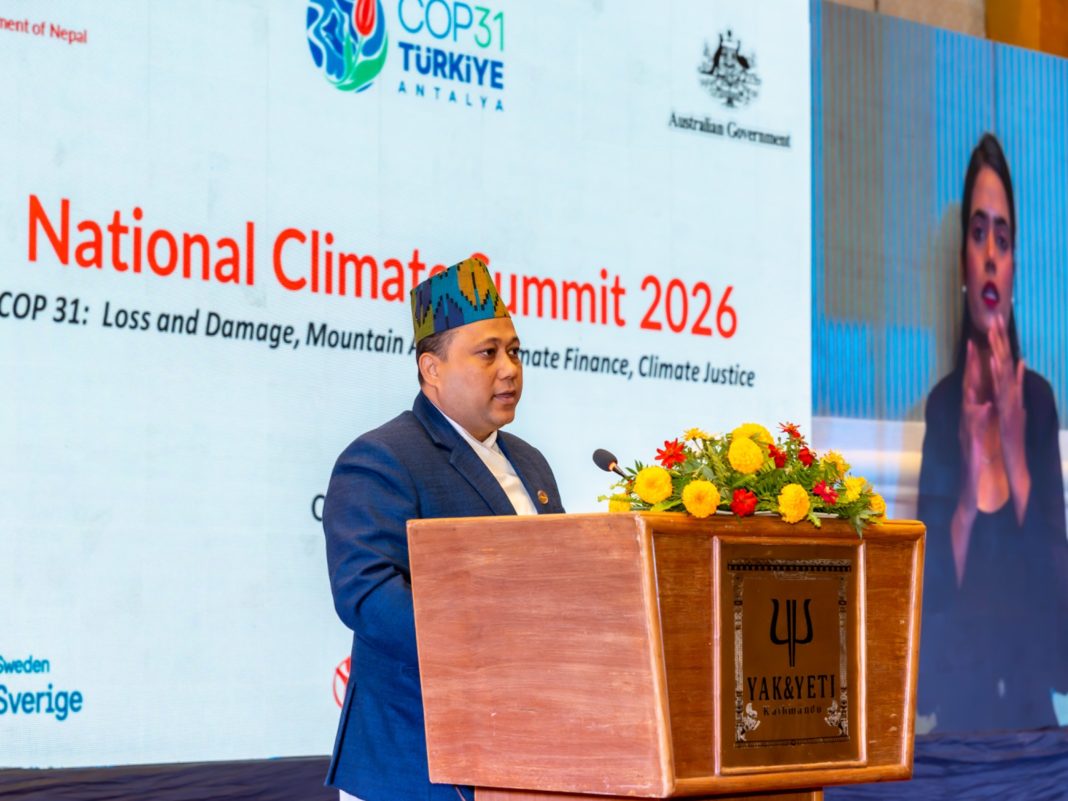

Minister for Foreign Affairs Shisir Khanal has said that Nepal will prioritize the Himalayan agenda, climate finance, and climate justice at the 31st Conference of the Parties (COP-31) under the United Nations Framework on Climate Change.
Addressing the National Climate Summit 2026 organized today in preparation for the COP-31 taking place in Antalya, Türkiye, Minister Khanal said, “In the upcoming COP-31, Nepal will prioritize and raise issues like the mountain agenda, climate-induced loss and damage, climate finance, and climate justice.”
He also mentioned that due to climate change, the ecological system of the Himalayan region is increasingly at risk.
“We gather at a particularly solemn moment. The devastating Himalayan Tsunami of 26 August, followed by successive floods and landslides, has inflicted immense human suffering and extensive damage upon our infrastructure, livelihoods, and economy. Preliminary assessments indicate that reconstruction and recovery from the August catastrophe alone will require approximately USD 4.7 billion, equivalent to nearly 10 percent of our national GDP,” he said.
Stating that behind these staggering figures lie families mourning their loved ones, communities struggling to rebuild, and decades of hard-earned development gains placed in jeopardy, the Foreign Minister said these tragedies have brought into sharp focus the growing fragility of mountain ecosystems and the far-reaching consequences of a warming planet.
“The ecological stability of the Himalayas is intrinsically linked to the water, food, energy, and economic security of millions extending far beyond our borders. Safeguarding our mountains is, therefore, a critical issue of national interest and a shared global responsibility,” he emphasized.
He also recalled that earlier this month, at the Pre-COP Leaders’ Event in Fiji, he had the opportunity to convey Nepal’s urgent call for global climate action and highlight four priorities that must guide our collective engagement at COP31.
Reiterating this call at the National Climate Summit, he said, “First, we must elevate the mountain agenda within international climate negotiations. The Paris Agreement’s 1.5°C temperature goal holds particular significance for mountain countries. Even temporary overshoot risks accelerating glacier retreat, destabilizing fragile ecosystems, and triggering irreversible environmental changes.
Nepal has consistently championed mountain concerns through the International Expert Dialogue on Mountains, People and Climate Change in 2024 and the Sagarmatha Sambaad in 2025. We look forward to carrying this momentum into the next Sagarmatha Sambaad in 2027.”
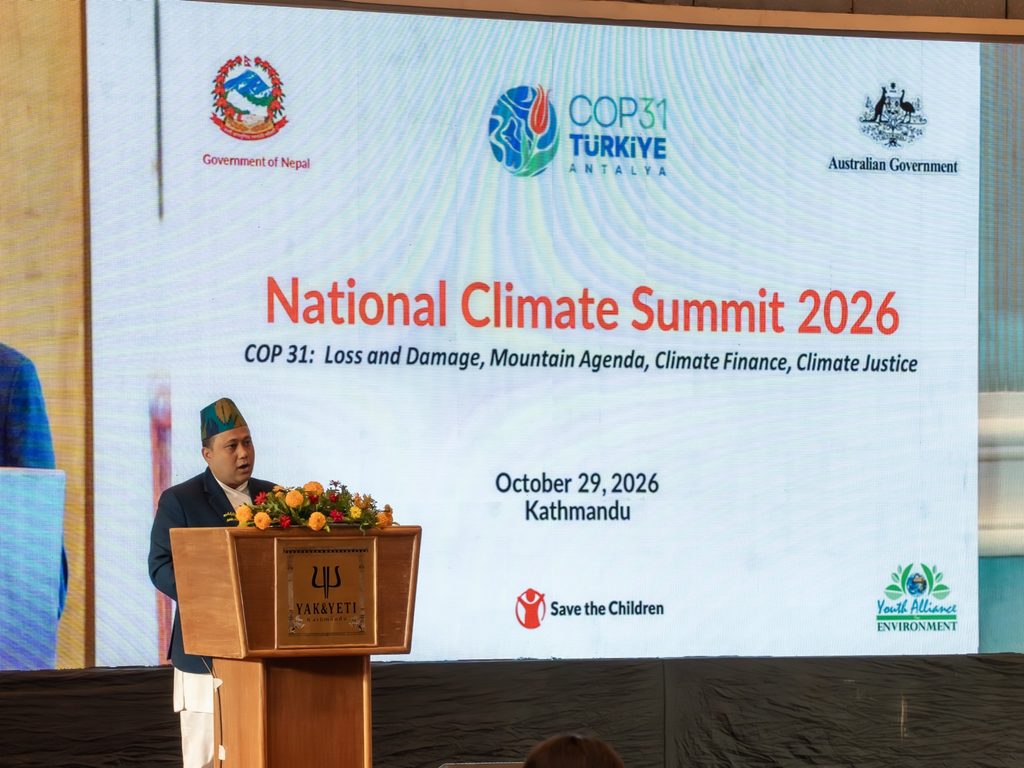
According to him, at COP31, Nepal will advocate for regular high-level dialogues on mountains, a dedicated mountain work programme, and the systematic integration of mountain-specific vulnerabilities into global climate frameworks.
The Minister for Foreign Affairs emphasized that addressing loss and damage must become a defining measure of international climate solidarity.
“Recent disasters have exposed the limits of existing adaptation capacities. Beyond economic devastation, the displacement of communities, erosion of cultural heritage, and disruption of traditional livelihoods represent profound and enduring losses,” he argued.
He viewed that the recent decision of the Fund for Responding to Loss and Damage to provisionally allocate USD 21.6 million to Nepal (comprising USD 20 million for recovery and reconstruction and USD 1.6 million for oversight fees), marks a milestone in international climate cooperation, with Nepal becoming the first country to secure such an allocation.
“We must now build upon this progress by ensuring adequate capitalization, simplified access, and timely disbursement, particularly for countries confronting catastrophic climate events. Nepal will continue advocating for predictable, grant-based resources and effective rapid-response mechanisms to support recovery and resilient reconstruction. Climate finance must be accessible, equitable, and responsive to national priorities,” Minister Khanal added.
Noting that Nepal has demonstrated its commitment through its Nationally Determined Contribution, National Adaptation Plan, and long-term low-emission development strategy, he said Nepal’s third Nationally Determined Contribution estimates adaptation financing requirements of approximately USD18 to 20 billion between 2025 and 2035.
“Building on the commitment made at COP30 to triple adaptation finance by 2035, Nepal will advocate for its timely and effective implementation, alongside improved access to climate funds, enhanced technology transfer, and strengthened capacity-building,” the Minister for Foreign Affairs said adding that Nepal will continue to uphold the principles of equity and common but differentiated responsibilities and respective capabilities.
“We will also emphasize predictable and grant-based financing that enables vulnerable countries to pursue climate resilience alongside sustainable development,” he said.
Reiterating that climate justice must remain at the heart of our collective response, Minister Khanal said Nepal’s negligible emissions stand alongside mounting climate losses.
He further said, “Meanwhile, our forests, glaciers, and mountain ecosystems sustain ecological stability well beyond our borders. A credible global climate framework must account for both the environmental contributions of vulnerable nations and the costs they disproportionately endure. Equally vital is ensuring that women, children, Indigenous Peoples, persons with disabilities, and marginalized communities have a genuine voice in decisions that shape their future.”
Foreign Minister Khanal pointed out that climate change has become increasingly crucial to Nepal’s foreign policy agenda.
“The Ministry of Foreign Affairs remains committed to advancing our national priorities through bilateral diplomacy, regional partnerships, and multilateral cooperation. To anchor this work, the Ministry has established a dedicated Climate Diplomacy Section.
Our diplomatic missions will continue to mobilize international partnerships, facilitate technological cooperation, and amplify Nepal’s climate concerns globally,” he informed the Summit.
He said, “As we approach COP31, Nepal must speak with a unified voice, guided by clear priorities and a steadfast commitment to implementation. Therefore, to translate our vision into measurable impact, I call for a coordinated, whole-of-nation approach.
Our collective success will ultimately be measured by the resilience of our communities, the preservation of our ecosystems, and the opportunities we secure for future generations.
May this Summit reinforce our shared resolve to advance Nepal’s climate priorities on the global stage and secure meaningful outcomes for our people and future generations.”
On the occasion, he commended the Ministry of Agriculture, Forests and Environment for convening this timely gathering. The Minister also acknowledged the development partners, scientific institutions, and climate practitioners for their valuable contributions.
He also expressed his appreciation for the perspectives shared by the distinguished speakers from ADB, ICIMOD, the United Nations, and the COP31 Presidency.
Documents unveiled
On the occasion, Minister Khanal and Minister for Agriculture, Forests and Environment, Gita Chaudhary jointly launched the Mountain Strategy and Climate-related Policy Documents. These initiatives reflect Nepal’s continued commitment to strengthening climate resilience and advancing our national priorities.