
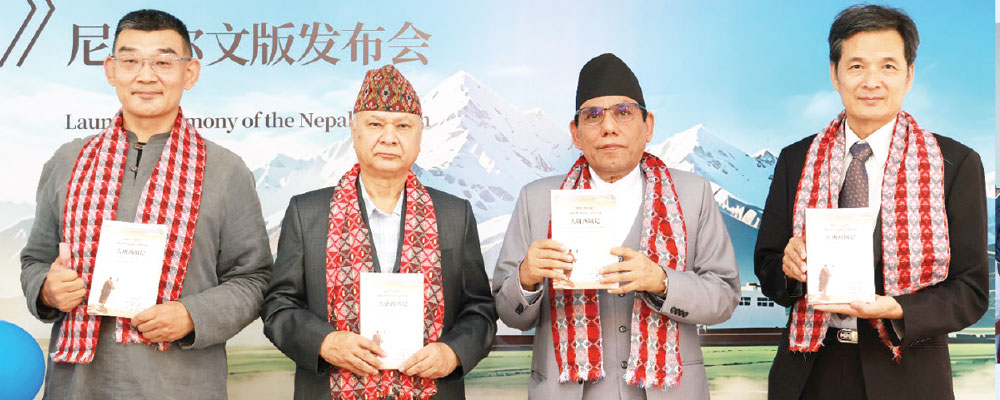

‘Great Tang Records on the Western Regions’ – a book that details travelogues of a Chinese monk Xuanzang’s Nepal visit – is launched in Kathmandu on Friday.
The edited Nepali translation of the volume was released by Chairman of the National Assembly Narayan Prasad Dahal, former minister Raghuji Panta, Chinese translator Fu Qiang, and editor of the book Ganesh Kumar GC.
Speaking on the occasion, Chairman Dahal said that the publishing of the historically significant book in Nepali language is a commendable initiative that will promote greater mutual understanding between the people of Nepal and China. “It will broaden their shared appreciation of history, culture and heritage of both the nations. I believe people to people contacts and cultural ties will contribute to strengthening the ending friendship,” he said.
According to him, the publication of the book represents a meaningful effort to strengthen cultural understanding, mutual respect, and bilateral relations between Nepal and China, and will leave a lasting mark in the history of cultural exchange between the two countries.
Likewise, Panta termed the publication as a good initiative to enhance understanding about China and historical relations between the two neighbours.
Speakers at the event discussed expansion of Buddhism from Nepal to Tibet and China, Bhrikuti’s marriage with the Tibetan King and said that the people-to-people bilateral relations between the two countries existed thousands of years before the governments established formal ties.
Chinese translator Fu expressed his happiness that such an important volume is published in the Nepali language.
Xuanzang had come to Lumbini Nepal via Afghanistan and India about 1400 years ago. He wrote the book after returning to China. He was born in Hennan province in 602 AD. He extensively studied Buddhism and met several Buddhist monks and scholars. He had reached Nepal after completing an arduous journey via Kyrgyzstan, Kazakhstan, Uzbekistan, Afghanistan and India.
It took him about three years to reach Nalanda in modern-day Bihar which was an education hub then. He remained there for several years to get himself educated. He visited Lumbini and Kapilvastu around 636-637. He has described the monuments, the holy pond, Ashoka Pillar and other attractions.
Although most of the monuments and structures have withered or lost with the time, Xuanzang’s book is a time travel to the lost times and understanding of the civilisations in South Asia including Nepal.
The book is also a testament that Lumbini was the birthplace of Lord Buddha. “Today, as we publish this work in the Nepali language, we hope that more Nepali readers will be able to rediscover ancient Nepal, India and Asia through Xuanzang’s 1,400-year-old account, thus gaining insight into the history of the spread of Buddhism and exchange between different civilisations,” said Fu.