

When the swollen waters of the Bhotekoshi River tore through homes, hydropower projects, and livelihoods in late August, the devastation carried a message that transcended national boundaries. For Foreign Minister Shisir Khanal, it was a painful reminder that in the Himalayas, geography does not merely divide nations—it binds their fate.
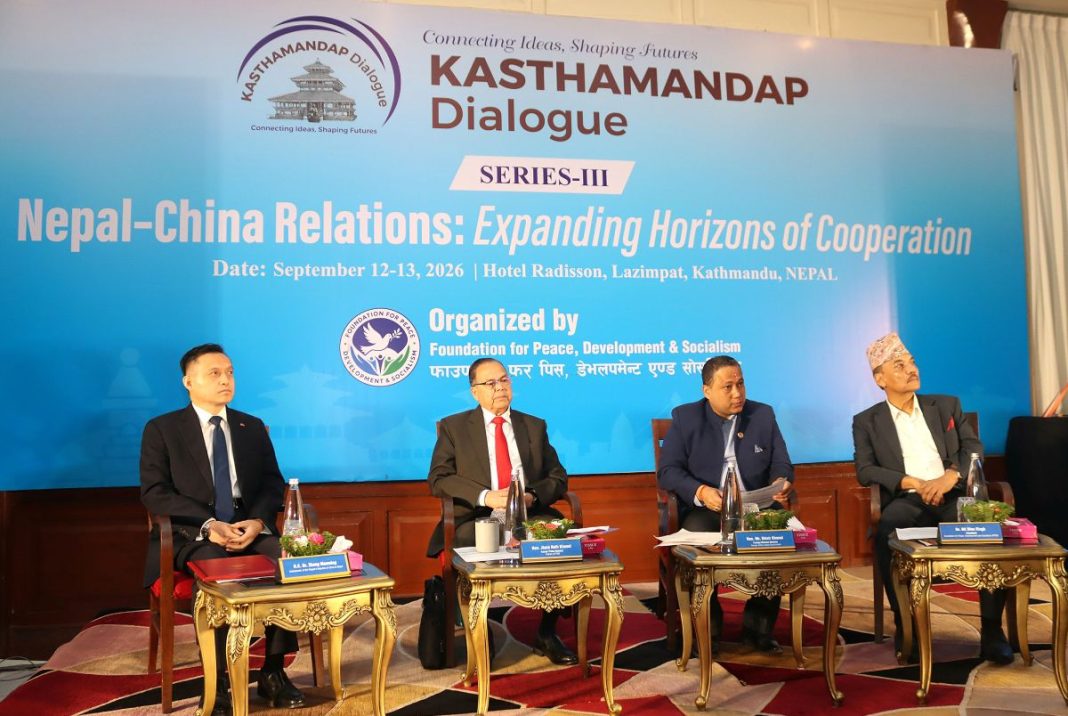
“The disaster of August 26 was obviously a severe trial, but it has not broken the national resolve,” Khanal declared, speaking at a dialogue on ‘Nepal-China Relations: Expanding Horizons of Cooperation’ organized by the Foundation for Peace, Development and Socialism (FPDS) in Kathmandu on Saturday.
The event, which brought together diplomats, policymakers, and former leaders, underscored a pivotal shift in Nepal-China relations: from conventional border management to what Khanal termed a “proactive ecological partnership.”
Khanal’s address struck a chord that resonated beyond diplomatic niceties. “Nature does not recognize administrative divisions,” he said. “When glacial lakes swell, when weather patterns shift erratically, or when fragile mountain slopes give way, the hazard is trans-boundary.”

His words carried the weight of recent tragedy. The Bhotekoshi floods and debris flows—which Chinese Ambassador Zhang Maoming described as “another painful reminder”—devastated communities on both sides of the border, destroying homes, industries, and critical infrastructure.
The foreign minister called for a fundamental reimagining of bilateral cooperation. “Environmental resilience and climate security must become the bedrock of our 21st-century statecraft,” he urged, adding that the Himalayas must not be remembered as a barrier but embraced as a “shared sanctuary that demands collective stewardship.”
The dialogue yielded concrete proposals for translating rhetoric into reality. Khanal outlined a vision of real-time satellite data-sharing, joint meteorological forecasting, and coordinated early-warning networks against glacial lake outburst floods. Such mechanisms, he argued, could “benefit ecological shocks before they claim lives.”
Ambassador Zhang echoed this sentiment, revealing that China’s intelligent meteorological early-warning solution—the MAZU system—has been developed specifically to share cross-border climate information. “China is ready to work with Nepal in information sharing in hydrological and meteorological problems,” he affirmed.
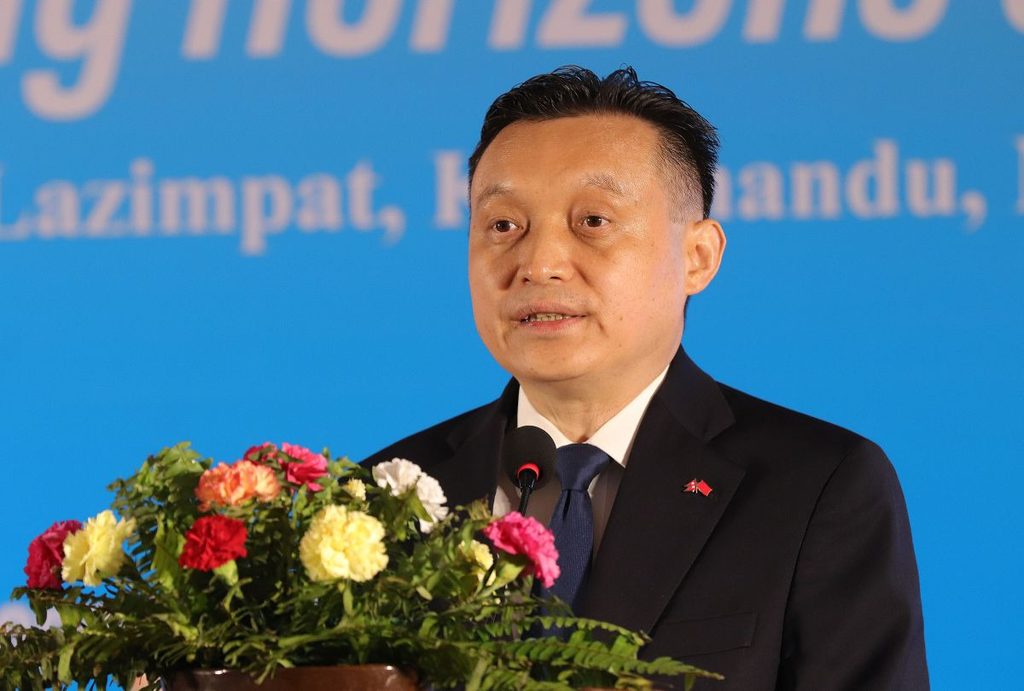
The ambassador emphasized that political parties and governments with effective coordination and implementation capacity can “exercise strong overall planning, coordination, organization and mobilization in the face of major disasters, and effectively safeguard people’s lives and property.”
Beyond climate cooperation, Khanal addressed a thornier issue: the structural imbalance in bilateral trade. “While China is our largest source of Foreign Direct Investment and our second-largest trading partner, a bilateral trade deficit exceeding 15 billion Yuan is structurally unsustainable,” he acknowledged.
The foreign minister proposed practical solutions, including technical cooperation for quarantine harmonization and the prompt establishment of a certified Multi-Functional Laboratory in Nepal. Such measures, he said, would enable high-value Nepali agro-products—specialty coffee, tea, and medicinal herbs—to genuinely benefit from duty-free access to China’s vast consumer market.
He also invited high-grade Chinese investment into clean manufacturing, ecotourism, and agro-processing, sectors that could diversify Nepal’s economy while preserving its environmental heritage.
Former Prime Minister Jhala Nath Khanal offered a broader perspective, arguing that stronger physical and digital connectivity could expand trade, tourism, investment, and people-to-people relations. He called for greater seriousness in advancing agreed projects under the Belt and Road Initiative (BRI), particularly the Trans-Himalayan Multidimensional Connectivity Network.
“The two countries are committed to translating this network from a visionary blueprint into tangible arteries on the ground,” Foreign Minister Khanal affirmed. But he cautioned that this demands “disaster-resilient upgrades” across northern gateways—modernizing customs checkpoints, operationalizing high-altitude border ports into year-round commercial hubs, and rebuilding severed highways and bridges with “climate-hardened engineering capable of withstanding ecological shocks.”
Former Prime Minister Khanal also situated these developments within a shifting global landscape, referencing China’s rise, the growing relevance of the Shanghai Cooperation Organisation, trends toward de-dollarization, and the gradual shift of global influence toward the Global South. Nepal, he argued, must “carefully assess these transformations and position itself strategically within the emerging global order while protecting its sovereignty and national interests.”
Looking to the future, Foreign Minister Khanal proposed establishing joint innovation laboratories, institutional incubation centers, and structured technology transfer programs. “Nepal and China can co-develop AI-driven solutions tailored for mountain economies—optimizing precision agriculture, digitizing public service delivery, and automating disaster risk responses,” he said.
The former prime minister echoed this forward-looking vision, encouraging Nepali youth to develop capacities in technology, entrepreneurship, and digital innovation. “Cooperation in science, technology and innovation could become an important new pillar of Nepal–China relations,” he said.
Ambassador Zhang highlighted China’s extensive support following the Bhotekoshi floods as evidence of enduring friendship. China donated Bailey bridges, diesel generators, medical protective masks, mortuary freezers, DNA testing equipment and reagents, and water rescue equipment. Additionally, 24 experts specializing in tunnel rescue, DNA testing, and forensic sectors are supporting Nepali teams.
“We need to deliver benefits to future generations through ecological and biodiversity conservation,” Zhang said, emphasizing a people-centered approach. “By doing so, we can rally the broadest social forces to combat severe disaster and forge a powerful cooperation.”
As Nepal champions “mountain diplomacy” on the world stage—advocating for climate finance, technology access, and loss and damage mechanisms—its partnership with China, Khanal suggested, “must model how two mountain neighbors protect their shared roof of the world.”
The dialogue concluded with a sense of cautious optimism. The challenges are immense: a warming climate, fragile mountain ecosystems, trade imbalances, and the ever-present threat of natural disasters. But the message from Kathmandu was clear: in the Himalayas, isolation is not an option.
As Foreign Minister Khanal put it, the August tragedy “brought home an undeniable truth that between Nepal and China, geography does not merely mark a political boundary, it binds their shared destiny.”
In an era of climate uncertainty, that destiny—and the cooperation it demands—may prove to be the most enduring bridge of all.