
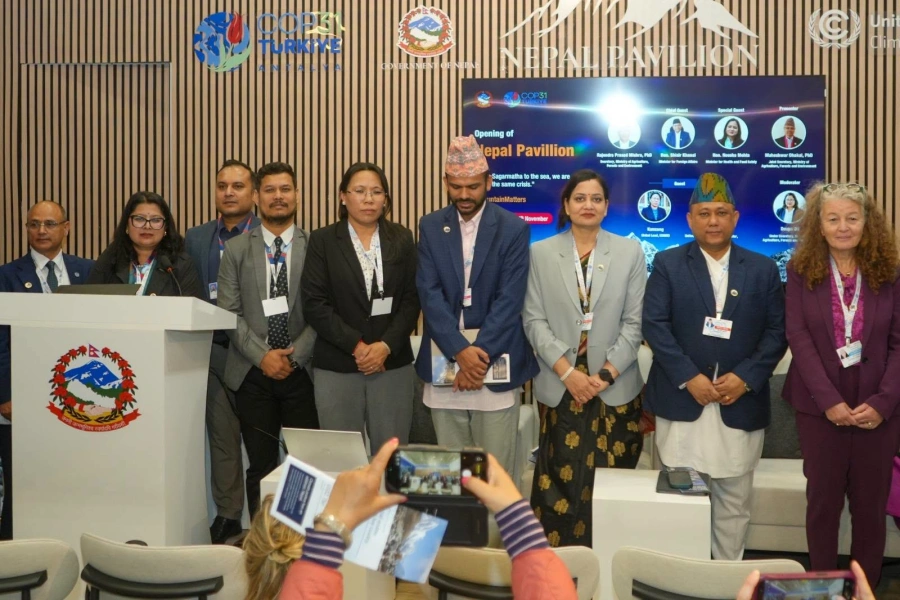

NTALYA, Türkiye—At the sprawling Expo Centre hosting the 31st Conference of the Parties (COP31), Nepal’s pavilion occupies just 48 square meters—a modest footprint in a venue where more than 150 national and institutional spaces compete for attention. Yet inside this small hall, beneath a silhouette of Mount Everest and photographs of the devastating Bhotekoshi floods, a quiet but determined diplomacy is unfolding.
The pavilion has become a hub for Nepali delegates, scientists, diaspora members, and international partners, hosting 48 events over the two-week conference—four to five programs a day. Barbados Prime Minister Mia Mottley and climate campaigner Harjeet Singh are among those who have participated in discussions here, giving Nepal an opportunity to present its concerns directly to the international climate community.
But the pavilion is only one part of Nepal’s engagement at COP31. On the negotiating floor, a joint proposal by Nepal, Bhutan and Kyrgyzstan has achieved a significant breakthrough: the inclusion of mountain regions and climate change in the draft cover decision of COP31, currently under way in Antalya from November 9 to 20.
The draft, titled “Presidency-led Party-driven Cover Decision” and dated November 16, includes a proposal to establish a separate work program on mountain regions and climate change. Paragraph 31 of the draft proposes that the program strengthen scientific research on mountain regions, assess climate change impacts, and improve adaptation measures and risk reduction efforts. The draft also proposes including mountain-related issues permanently on the COP agenda and organizing a high-level dialogue on the subject at COP32.
The inclusion recognizes that mountain regions and communities dependent on glaciers are particularly vulnerable to the adverse impacts of climate change. In UN climate negotiations, a cover decision is the overall political document issued at the end of a COP, bringing together outcomes on different issues and setting the conference’s political direction.
Nepal and Bhutan had jointly proposed an initiative titled “Impacts of 1.5 Degrees Celsius of Global Temperature Rise on Mountain Regions,” while Kyrgyzstan had proposed institutionalizing regular high-level dialogues on mountain regions and climate change. Through these proposals, the three countries sought to bring accelerated glacier melting, the risk of glacial lake outburst floods (GLOFs), impacts on water resources, biodiversity loss, and increasing climate-related disaster risks in the Himalayas and other mountain regions to the forefront of international climate negotiations.
Climate Justice on the Ministerial Agenda
On the sidelines of COP31, Agriculture, Forests and Environment Minister Geeta Chaudhary addressed a high-level ministerial dialogue on loss and damage organized by the United Nations Development Programme (UNDP), where she made an impassioned case for climate justice.
“Loss and damage is not an abstract debate for Nepal but a daily reality,” Chaudhary said, noting that Nepal contributes less than 0.1 per cent of global greenhouse gas emissions yet faces severe climate impacts—accelerated glacier melting, GLOFs, landslides, droughts, forest fires and extreme rainfall that have seriously affected people’s lives, livelihoods, infrastructure, and ecosystems.
She said that despite investments in adaptation, preparedness, and disaster risk reduction, some climate-related impacts could not be prevented or adequately managed. Linking loss and damage with climate justice, she emphasized that communities contributing the least to emissions were suffering the greatest losses.
Chaudhary welcomed progress in implementing the Fund for Responding to Loss and Damage and appreciated the fund board’s decision to provide support to Nepal following the Rasuwa-Bhotekoshi disaster, describing it as an important expression of international solidarity. She noted, however, that the financial needs arising from climate-related losses were far greater than the resources currently available. She also said that the visit of United Nations Secretary-General António Guterres to Nepal had helped highlight the severity of the climate crisis in the Himalayan region to the international community.
Nepal has prioritised strengthening national systems and building climate resilience. With support from UNDP and other development partners, the country is working on the National Climate Policy, Nationally Determined Contribution (NDC), glacial lake risk reduction, early warning systems for all, disaster recovery and a national strategy on loss and damage caused by climate change.
A Home Away from Home
For the Nepali community at COP31, the pavilion serves as more than a venue—it is a gathering place. Binod Paudel, president of the Non-Resident Nepali Association (NRNA) in Türkiye, who helped manage the pavilion, describes it as a home away from home.
“It is a bridge connecting people with the country. Such pavilions can also help reconnect the second and third generations, whose ties with Nepal may gradually be weakening,” Paudel says. In his view, COP is not merely a gathering of government representatives and climate negotiators but also an opportunity for Nepali communities scattered across the world to meet, build networks and explore avenues for cooperation.
“Wherever the conference is held, we should mobilise the Nepali diaspora. We also want to be part of this broader effort,” he says.
Dr Maheshwor Dhakal, spokesperson for the Ministry of Agriculture, Forests and Environment, says the pavilion’s greatest value lies in the opportunities it creates for interaction and dialogue. “The pavilion has created an opportunity to bring all Nepalis together in one place and help people from around the world understand Nepal,” he says. “This year’s pavilion has been particularly active and vibrant.”
For Nepali scientists working abroad, the conference is also a chance for mutual learning. Dr Shobhakar Dhakal, a Nepali scientist involved in research and teaching in Bangkok, acknowledges concerns about the carbon emissions generated by international climate conferences but believes such gatherings are necessary to build momentum and collective commitments. “Global agendas need momentum to move forward. These conferences provide that momentum,” he says. “Such gatherings are essential for cooperation, dialogue and coordination.”
Tek Bahadur Sapkota, another Nepali scientist who conducts research and teaches on food-related issues in Mexico, sees the conference as an opportunity for mutual learning. “These conferences help us understand and learn what others are doing. Learning is a two-way process, and that is one of their important purposes,” he says.
Building Political Ownership
Nepal’s relatively large delegation at COP31—including ministers from the finance, foreign affairs and health ministries and more than a dozen lawmakers representing different political parties—has attracted attention. Dr Maheshwor Dhakal views this participation as an opportunity to strengthen political ownership of climate action.
“Climate change is not merely the responsibility of the environment ministry. Its impacts cut across the economy, health, agriculture, infrastructure and overall development,” he says. “Capacity-building on climate issues is necessary for all stakeholders. Political ownership helps advance climate action within the country.”
He believes the participation of ministers and lawmakers will help integrate climate concerns into different levels and sectors of government. “It will now become easier to mainstream climate action. We will no longer have to keep asking other ministries to support the implementation of the National Adaptation Plan and NDCs. The leadership of the respective ministries will also take responsibility,” he says.
Nepali parliamentarians have also had opportunities to share experiences with their international counterparts, and Dhakal welcomes the participation of younger political leaders, women and young people—some attending such conferences for the first time, others using the opportunity to further strengthen their knowledge and capacity.
Looking Ahead
As COP31 continues, Nepal’s engagement illustrates how a country with negligible emissions but acute vulnerability can use international climate diplomacy to amplify its voice. The joint mountain proposal, the ministerial push for loss and damage financing, and the bustling pavilion all reflect a broader strategy: turning visibility into influence, and international commitments into national action.
Dhakal believes that in the coming years, civil society and the private sector should increasingly take the lead in maintaining Nepal’s presence at such forums. “Our expectation is that civil society and the private sector will take the lead in the coming years,” he says.
For now, the small pavilion in Antalya stands as a testament to Nepal’s determination—proof that in the global fight against climate change, size is no measure of significance.