
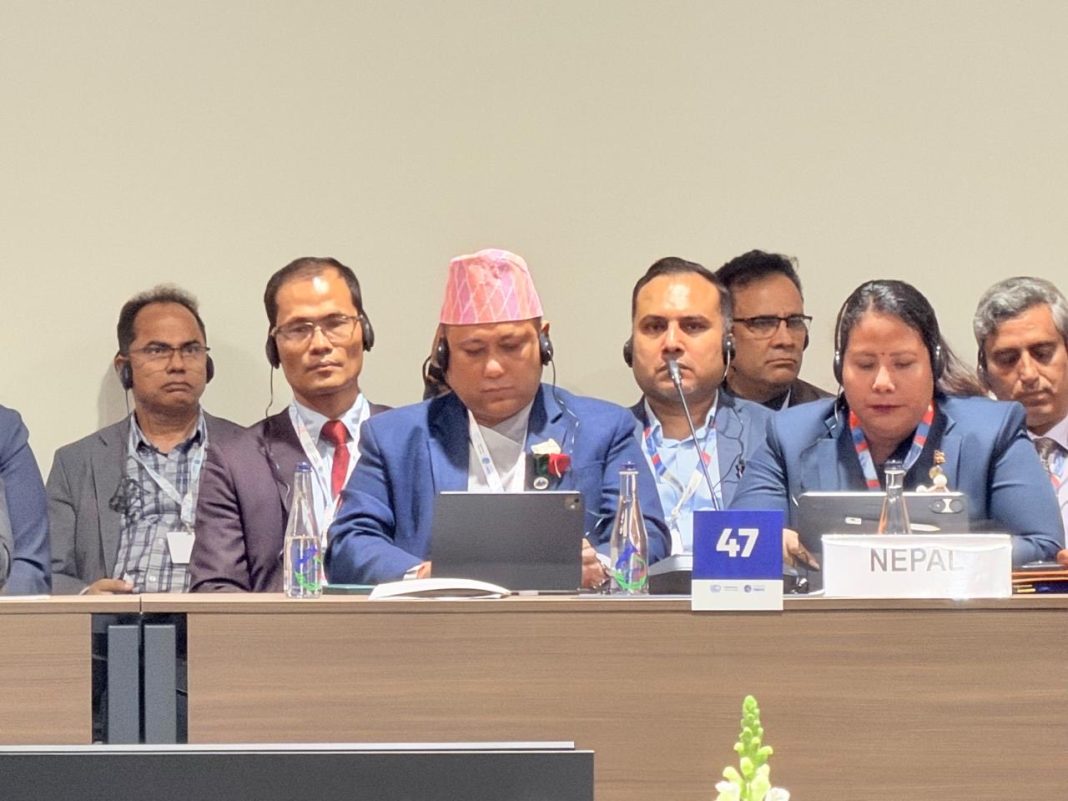

Subodh Sharma, ANTALYA, Türkiye
Nepal’s Foreign Minister Shisir Khanal brought the plight of the world’s mountain regions to the center of the global climate stage this week, warning at COP31 that the accelerating melt of glaciers and snowfields threatens not just Himalayan nations but the water and food security of the entire planet.
Speaking at a high-level discussion on “Advancing the Mountain Agenda: Melting Temperatures, Shared Responsibility, and Sustainable Financing for Glaciers, Snowfields, and Resilience,” Khanal delivered a stark message to delegates gathered in the Turkish coastal city: “When the mountains are in crisis, all of humanity is in trouble.”
The event, held on the sidelines of the 31st Conference of the Parties to the United Nations Framework Convention on Climate Change, drew participation from Nepal’s Minister for Agriculture, Forests and Environment Gita Chaudhary, as well as ministers and representatives from Tajikistan, Kyrgyzstan, Bhutan, and Pakistan — a coalition of mountain nations whose shared vulnerabilities are increasingly shaping the global climate dialogue.
A “Himalayan Tsunami”
Khanal did not speak in abstractions. He pointed to the devastating flood that swept through Nepal’s Himalayan region on August 26 — an event he described as a “Himalayan tsunami” — when the collapse of glaciers and rocks unleashed a fast-flowing, sediment-laden torrent that destroyed bridges, hydropower structures, and the livelihoods of local communities, claiming lives and leaving devastation in its wake.
The minister noted that the recent climate-triggered Bhotekoshi floods had prompted a message of sympathy and solidarity from UN Secretary-General António Guterres, whom Khanal met separately on the COP31 sidelines. During that meeting, Khanal expressed deep appreciation for the Secretary-General’s steadfast leadership of the United Nations and his commitment to multilateralism, global peace, human dignity, and sustainable development.
Guterres, in turn, acknowledged Nepal’s valuable contribution to global peace and stability as a leading troop- and police-contributing country to UN peacekeeping missions. The two leaders exchanged views on matters of regional and global significance, including Nepal’s recovery and reconstruction efforts, the indispensability of global governance reforms, multi-hazard early warning systems, scaled-up climate finance, and climate action.
The Mountains Are Changing “Within Human Lifetimes”
In his remarks to the mountain agenda discussion, Khanal painted a vivid picture of a crisis unfolding at unprecedented speed.
“Our glaciers and mountain peaks, which have formed over thousands of years, are changing rapidly within human lifetimes,” he said. “The impact reaches not only mountains but also river systems, economies, ecosystems, and eventually the seas.”
The melting of glaciers, shrinking snowfields, and increasing disaster risks in mountain regions, he warned, are adding mounting challenges to global water and food security. The effects of the growing climate crisis, he added, “are not being limited to mountain regions alone but affect the global economy, ecological systems, and human life.”
A Question of Climate Justice
Central to Khanal’s message was a pointed reminder of the inequity at the heart of the climate crisis. Countries like Nepal, which contribute negligibly to global greenhouse gas emissions, bear a disproportionate burden of its consequences, he said.
He emphasized the need to accelerate global emission reductions to achieve the target of limiting temperature rise to 1.5 degrees Celsius, but cautioned that even if temperatures temporarily rise and then fall again, “the glaciers that melted and the destroyed communities will not immediately return to their previous state.”
“For mountainous nations, exceeding the temperature limit is not just a temporary statistical deviation; its consequences are long-term,” he added.
Five Priorities for Mountain Resilience
Khanal presented five priorities on behalf of Nepal for the protection of mountainous areas and the enhancement of climate resilience: ambitious emission reduction, grant-based climate finance, effective loss and damage management, science-based monitoring and early warning systems, and institutional recognition of mountain issues within the United Nations climate change framework.
He emphasized that predictable, easily accessible, and grant-based climate finance should be provided to mountain countries for adaptation, resilient infrastructure, and sustainable livelihoods.
“It is not fair to force disaster-affected and at-risk countries to rebuild solely through loans,” he said.
Similarly, he argued that resources from the loss and damage fund should be delivered quickly, directly, and fairly to frontline mountain communities. He also called for increased investment in regular glacier monitoring, satellite-based observation, regional data exchange, and multi-hazard early warning systems.
“From the Himalaya to the Sea”
Looking beyond Nepal’s borders, Khanal shared that Nepal has proposed a “From the Himalaya to the Sea” partnership to promote collaboration, knowledge exchange, and collective efforts between mountain and coastal communities — recognizing that the fate of glaciers and oceans is inextricably linked.
Highlighting that Nepal’s “Sagarmatha Call for Action” has provided a clear roadmap for implementing the mountain agenda, he stressed that international cooperation is necessary to make the proposed UN Decade of Mountain Resilience effective.
A Defining Moment
As COP31 negotiations continue, Nepal’s intervention underscores a growing push by mountain nations to secure their place at the center of global climate action — not as peripheral victims, but as essential stakeholders in a crisis that, as Khanal put it, connects the highest peaks to the deepest seas.
The message from Antalya was unmistakable: the mountains are melting, and the world cannot afford to look away.