

By Staff Reporter, New Delhi, 23 November
Nepal and India on Monday signed eight memorandums of understanding (MoUs) spanning forensic science, security, health, satellite communications, and urban development, as Prime Minister Balendra Shah concluded his first bilateral foreign visit since taking office in March.
The agreements were signed during Shah’s two-day state visit to India, which began on Sunday at the invitation of Indian Prime Minister Narendra Modi. The two leaders held delegation-level talks at Hyderabad House in New Delhi, discussing the full range of bilateral relations and exploring ways to expand cooperation in trade, transit, energy, infrastructure, and connectivity.
Eight Agreements Signed
The MoUs include an academic and research collaboration agreement between the National Forensic Sciences University in Gandhinagar, Gujarat, and Nepal Police’s Crime Investigation Department. A second agreement was signed between India’s Rastriya Raksha University and Nepal’s National Police Academy.
The two countries also signed an MoU on capacity-building training programs for Nepali civil servants, involving India’s National Centre for Good Governance under the Department of Administrative Reforms and Public Grievances, and Nepal’s Administrative Staff College under the Ministry of Federal Affairs and General Administration.
Other agreements cover cooperation in Ayurveda and traditional systems of medicine, sustainable urban development, health and medicine, and livestock and fisheries development. Nepal’s Ministry of Information and Communication and the Indian Space Research Organization (ISRO) also signed an agreement on establishing a satellite communication network for the utilization of the South Asia Satellite.
According to officials, the eight MoUs are aimed at strengthening bilateral cooperation and institutional partnerships between the two countries across various fields.
India Announces Rs 2 Trillion Plus Package, Kandla Port Access
In a significant economic gesture, Prime Minister Modi announced a cooperation package of 24 billion Nepalese rupees (approximately 2 billion USD) for post-Bhotekosi flood reconstruction and long-term development. The announcement came after bilateral talks between the two countries.
Modi also offered Nepal the use of India’s Kandla port, expanding the landlocked country’s access to maritime trade routes. Nepal currently uses the Visakhapatnam port, which India provided in 2016 during KP Sharma Oli’s tenure as prime minister. Before that, Nepal relied on the Haldia port.
Connectivity Projects Inaugurated
Earlier in the day, Shah and Modi jointly inaugurated a motorable bridge connecting Darchula in Nepal with Dharchula in India, and the second phase of the Motihari-Amlekhgunj petroleum pipeline project.
At a virtual ceremony following the bilateral talks, the two leaders also laid foundation stones for three projects: an integrated check post at Banbasa in India’s Uttarakhand state, a greenfield petroleum storage terminal in Jhapa, and the 669-megawatt Lower Arun Hydropower Project.
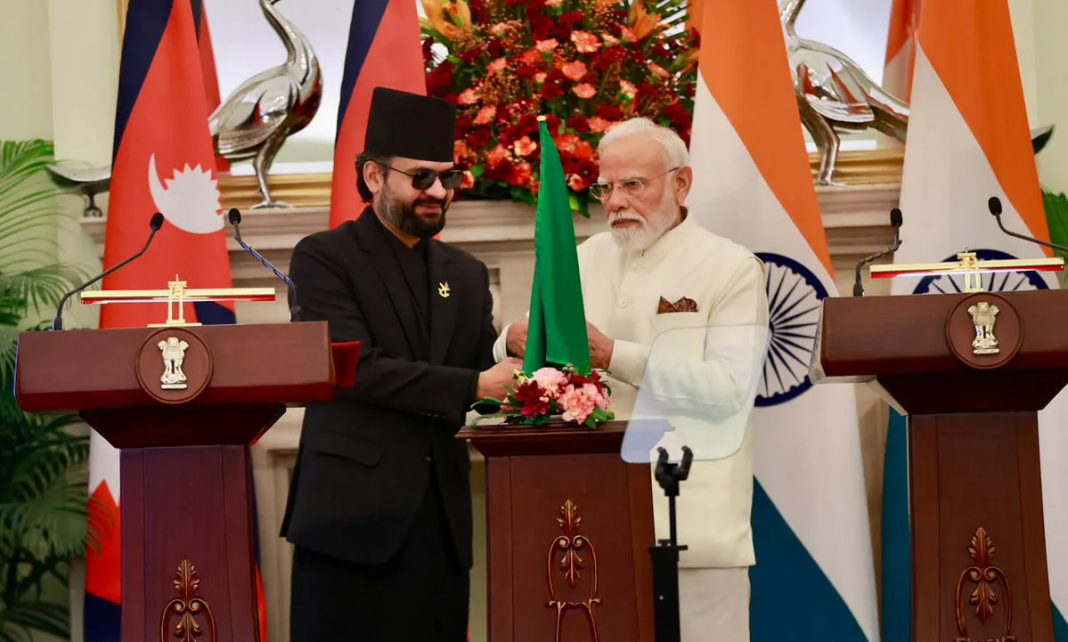
The leaders virtually flagged off the Saryu-Kamala Express, a new weekly passenger train service connecting Janakpur Dham in Nepal with Ayodhya Cantonment in India’s Uttar Pradesh. The 604-kilometre journey is expected to take around 19 hours, providing a direct rail connection between the two religious destinations without requiring passengers to change trains en route. Regular operations will begin on November 28.
The initiatives cover key areas of Nepal-India cooperation, including cross-border connectivity, energy infrastructure, petroleum supply and hydropower development.
Lower Arun Hydropower Project
The foundation stone for the 669-MW Lower Arun Hydropower Project was laid jointly by the two prime ministers through digital medium. The project, to be constructed in Sankhuwasabha’s Chichila Municipality and Khandbari Municipality, has an estimated cost of NPR 92 billion 67 crore.
A Project Development Agreement (PDA) was signed between Nepal’s Planning Board and the Indian company SJBHN Tallo Arun Power Development Company in 2080, with a target to complete construction within five years. Under the agreement, Nepal will receive 21 percent of the total electricity produced free of cost, and the project will be transferred to the Government of Nepal after 25 years of commercial production.
Land acquisition and compensation distribution are underway, with Rs 99 crore 98 lakh 39 thousand already distributed to about 253 affected families. The project is expected to contribute significantly to national electricity production and the economic development of Sankhuwasabha and the entire Kosi region.
Ceremonial Welcome
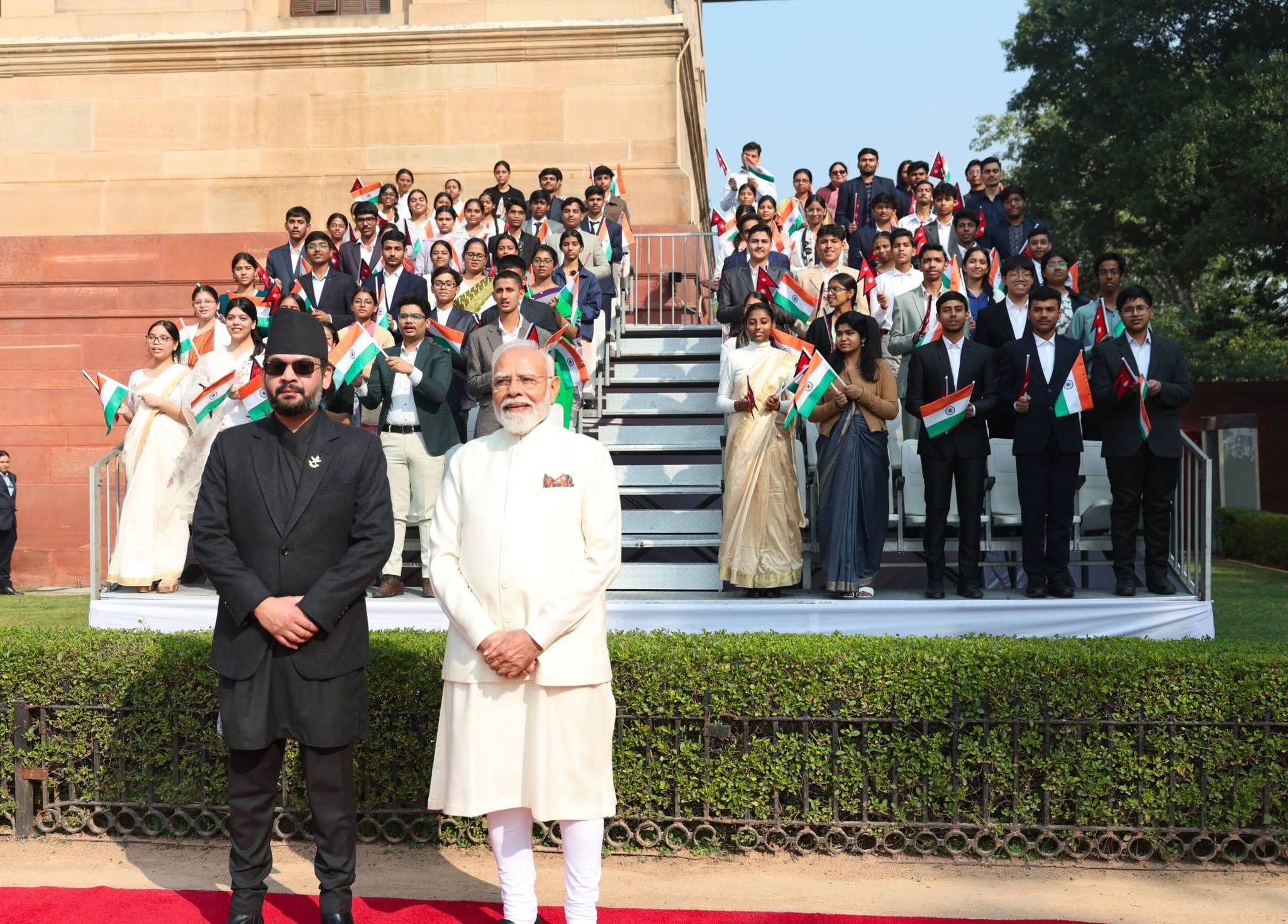
On Monday morning, Shah was accorded a ceremonial welcome at Rashtrapati Bhavan, where he received a guard of honor in the presence of Modi. He also paid floral tribute to Mahatma Gandhi at Rajghat before attending the bilateral meeting.
On Sunday, Shah met Indian External Affairs Minister S Jaishankar, who paid a courtesy call on the visiting prime minister. They discussed various aspects of bilateral relations, including connectivity, trade, transit, commerce, energy, culture, education, and people-to-people ties.
The visit underscores the deepening partnership between the two neighbors, with agreements spanning security, technology, health, urban development, and energy—sectors that officials say will shape the bilateral relationship for years to come.