
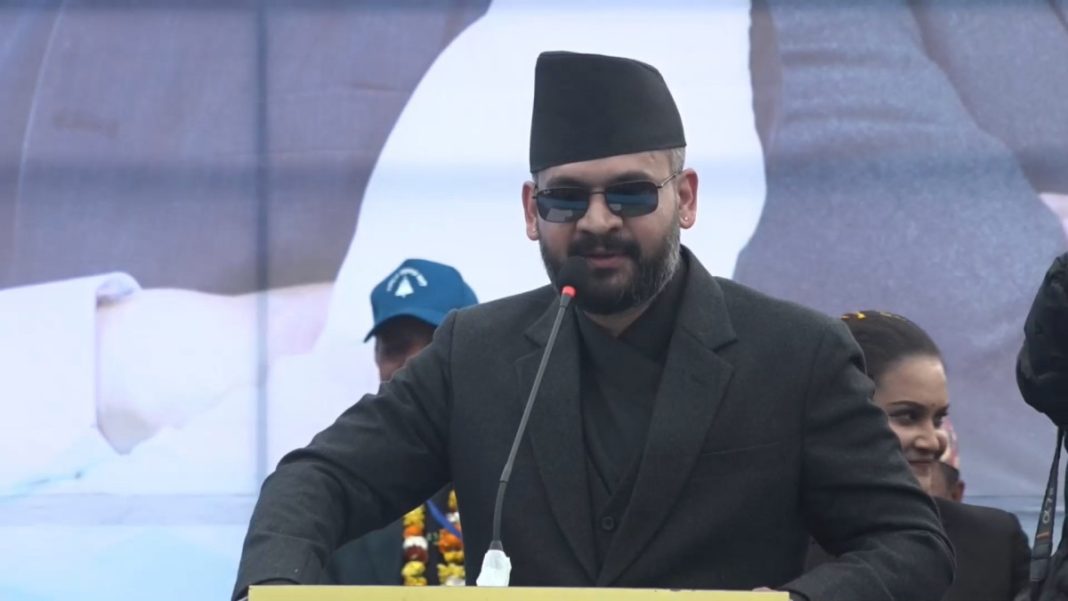

Nepali Prime Minister Balendra Shah has departed for New Delhi on Sunday afternoon for a two-day state visit at the formal invitation of Indian Prime Minister Narendra Modi, with financial cooperation, cross-border connectivity, and a long-pending air route dispute dominating the agenda.
Shah and his delegation left Kathmandu at 1:45 pm aboard a Nepal Airlines flight, and are scheduled to return home Monday evening at 6:35 pm on a regular Nepal Airlines service. The visit, taking place on November 22 and 23, was jointly announced by the two governments on Friday.
The delegation includes Finance Minister Dr. Swarnim Wagle, Foreign Minister Shisir Khanal, the Prime Minister’s Chief Advisor Kumar Byanjankar, other senior government officials, and Nepal’s Ambassador to India. A separate 52-member delegation of business representatives and journalists, traveling at their own expense, is also in New Delhi to take part in programs related to agreements, memorandums of understanding, and investment promotion between the two countries’ ministries and agencies.
According to officials, India has signalled a favorable response to Nepal’s request for $2 billion in grants and lines of credit, making financial cooperation a major priority of the visit. The two prime ministers are expected to hold separate one-to-one and delegation-level meetings on Monday, November 23, reviewing various aspects of bilateral relations.
Modi will host an official luncheon in honor of Shah on Monday. The Nepali prime minister is also scheduled to meet Indian President Droupadi Murmu the same day, while Indian External Affairs Minister Subrahmanyam Jaishankar will pay a courtesy call on Shah.
Despite anticipated progress on financial assistance, several aviation issues remain unresolved. Nepal and India have yet to agree on Nepal’s demand for an additional international air entry route through Indian airspace. India has proposed allowing its military aircraft to use the Bagdogra entry point, while Nepal maintains the arrangement should be limited to civilian flights.
The two sides also differ on flight altitude: India has proposed 39,000 feet for aircraft entering Nepal through Indian airspace, while Nepal wants it reduced to approximately 29,000 feet. Nepal is further seeking operationalization of the western air corridor, wanting the L626 (Kathmandu–Mahendranagar) route to function as a two-way international air corridor. Currently, international aircraft may exit Nepal through the western route but cannot enter.
The two prime ministers will jointly inaugurate a direct railway service between Janakpurdham and Ayodhya, strengthening cross-border connectivity and religious tourism, while foundation stones for several other projects will also be laid. Agreements and memorandums of understanding are likely to be signed in areas including human resource development, health, agriculture, sports, disaster management, development partnership, and start-ups.
Both countries also plan to unveil a joint vision document and joint communiqué outlining future cooperation priorities, though negotiations over the communiqué’s wording are still underway. The Nepal-India Business Forum will provide a platform to strengthen trade, investment, energy, water resources, technology, and connectivity cooperation.
The two prime ministers are expected to review bilateral relations and discuss regional and international issues during their meetings, with officials framing the visit as a step toward a shared vision for development and prosperity.