
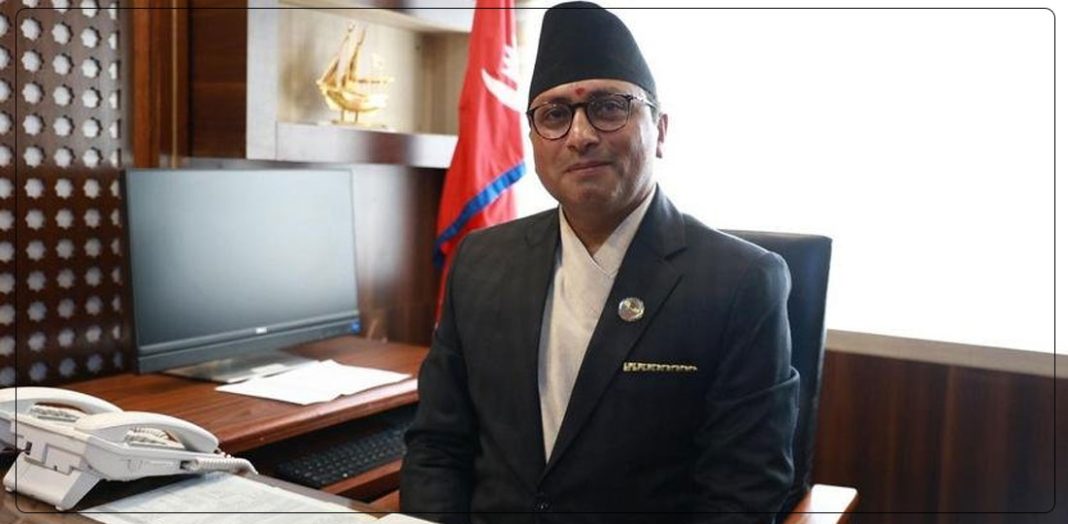

The Ministry of Finance has made public the “Current Economic Status of Nepal 2083,” outlining the country’s recent economic status.
Released on Monday, the white paper document reveals that Nepal’s economy is trapped in a serious structural crisis, with most economic indicators showing troubling trends.
Finance Minister Dr. Swarnim Wagle presented the white paper after completing one month in office, highlighting the problems and challenges facing the national economy and outlining a roadmap toward building a prosperous economy.
Economic growth remains low, unstable
According to the white paper, the nation’s economic growth has remained low and unstable.
The report states that the average economic growth rate over the past 10 years has been 4.2 per cent. During this period, the economy experienced fluctuations ranging from a contraction of 2.4 per cent to an expansion of up to 9 per cent.
For the current fiscal year, the white paper estimates economic growth at 3.5 per cent, whereas the budget had set a target of 6 per cent.
“Compared to the economic expansion of neighbouring countries, Nepal’s growth appears significantly slow,” the white paper stated.
The document also highlights that the condition of the productive industrial sector remains very weak.
The white paper has been unveiled setting ambitious targets to transform Nepal into a respectable middle-income country within the next five to seven years.
It envisions achieving an average annual economic growth rate of 7 per cent starting from the upcoming fiscal year. It also aims to raise per capita income to USD 3,000 and expand the size of the economy to nearly USD 100 billion.
However, over the past decade, the average contribution of the productive industrial sector to Gross Domestic Product (GDP) has been only 5.4 per cent. While the overall economy expanded at an average rate of 4.2 per cent during this period, the growth of the productive industrial sector was just 2.9 per cent.
According to the Ministry, the weak state of the industrial sector is due to inadequate investment, high dependence on raw materials, low adoption of innovation and advanced technology, and high production costs.
The white paper shows that the economy has shifted from agriculture to the service sector without sufficient industrialisation (premature de-industrialisation).
While the contribution of industry and agriculture to the economy is shrinking, the contribution of the service sector is expanding.
In the fiscal year 2015/16, the contribution of the agriculture sector was 28.4 per cent, and in 2024/25 it declined to 25.2 per cent, while the contribution of the service sector increased from 57.5 per cent to 62 per cent.
However, during the same period, the contribution of the industrial sector shrank from 14.1 per cent to 12.8 per cent.
Structural changes are needed to orient the economy toward income and productivity growth.
However, significant achievements have been made in electricity generation over the last decade. Since the start of electricity generation, installed capacity has increased nearly six-fold—from 697.85 megawatts to 4,105 megawatts by mid-March 2026.
The white paper states that the imbalance in foreign trade has reached an extreme level, with exports covering only 14.8 per cent of total imports. Of these exports, 42 per cent are edible oil, which has low value addition.
Due to significant remittance inflows, the external sector has remained stable. In the first eight months of the current fiscal year, remittances increased by 37.7 per cent to Rs. 1,449.65 billion.
The productive use of remittances could enhance national productivity.
The white paper states that 20.27 per cent of the population still lives below the poverty line. The unemployment rate has reached 12.6 per cent, and inflation pressures have made living standards difficult for ordinary citizens.