

Nepal occupies one of the most strategically consequential geographical positions in South Asia: a sovereign, landlocked state situated between two ascending civilisational powers, India and China. This location is not merely a cartographic fact; it constitutes the foundational variable of Nepal’s foreign policy calculus. As Prime Minister Balendra Shah assumes office with a historic electoral mandate, the imperative to reorient Nepal’s diplomatic posture—particularly toward its immediate neighbours—has never been more urgent. While the current administration’s emphasis on institutional protocol and “state-led” diplomacy reflects a commendable intent to depoliticise foreign engagement, an excessively inward-looking approach risks forfeiting a rare window of opportunity presented by convergent interests from New Delhi, Beijing, and the broader international community.
Contemporary Nepal–India–China relations unfold against a backdrop of profound strategic recalibration. India, having transitioned from normative post-colonial diplomacy to pragmatic, instrument-based statecraft, views stability in its northern periphery as integral to its own security architecture. Simultaneously, China’s Belt and Road Initiative (BRI) and its pursuit of trans-Himalayan connectivity reflect a systemic ambition to reshape regional economic and strategic linkages. For Nepal, this dual dynamic presents a paradoxical landscape: heightened sensitivity from New Delhi regarding external engagement in its neighbourhood, coupled with Beijing’s willingness to offer alternative development partnerships.
Scholars note that Nepal’s traditional balancing act—maintaining “equal diplomatic relations” with both neighbours—requires renewed sophistication in an era where great-power competition is increasingly expressed through infrastructure finance, digital connectivity, and supply-chain integration. The recent tentative rapprochement between India and China does not diminish this complexity; rather, it introduces new variables. Nepal must navigate not only bilateral sensitivities but also the potential for trilateral economic corridors, such as proposed China–India–Nepal connectivity frameworks.
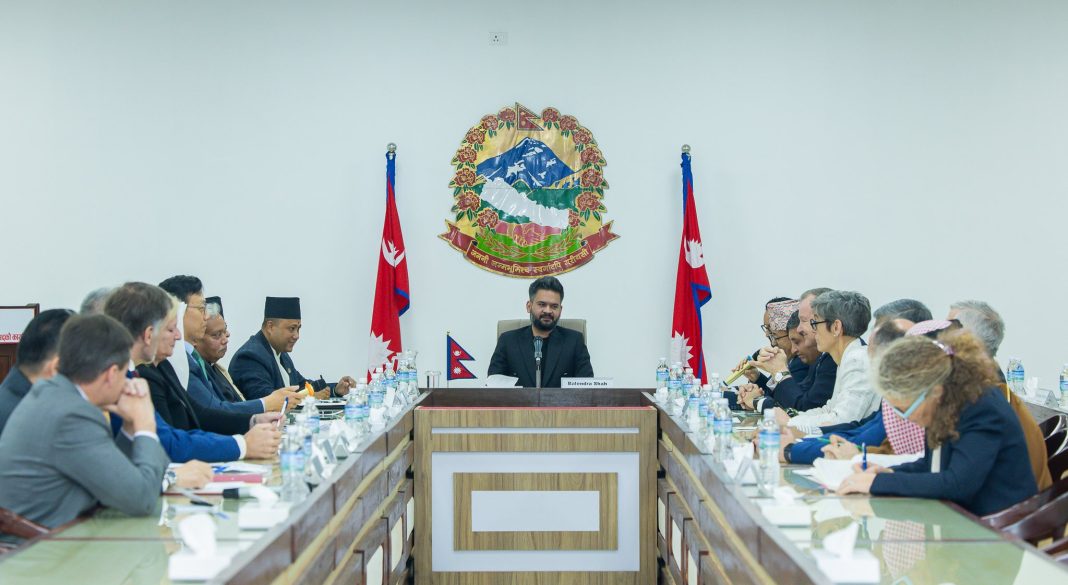
The Shah administration’s decision to convene joint meetings with resident ambassadors and to reinforce the Ministry of Foreign Affairs’ coordinating role represents a deliberate effort to consolidate foreign policy authority and reduce ad hoc, personality-driven engagements. Proponents rightly argue that such measures strengthen institutional diplomacy and mitigate risks of mixed messaging. However, critics contend that an overly rigid interpretation of diplomatic protocol—exemplified by reported hesitations to engage individually with visiting senior envoys or foreign ambassadors—may inadvertently signal disengagement at a moment when high-level political outreach is most valuable.
This caution appears particularly consequential vis-à-vis India and China. Both capitals place significant weight on direct leader-to-leader communication as a mechanism for building trust, resolving sensitivities, and advancing substantive cooperation. When Prime Minister Shah reportedly declined bilateral meetings with visiting US dignitaries citing protocol, the gesture, while procedurally defensible, may have been interpreted in New Delhi and Beijing as reluctance to prioritise neighbourhood diplomacy. In a region where personal rapport among leaders often facilitates breakthroughs on complex issues—from cross-border hydropower projects to transit arrangements—such perceptions carry tangible costs.
Nepal’s geopolitical significance derives not from its size or military capacity, but from its location at the intersection of two of Asia’s most dynamic strategic trajectories. Prime Minister Balendra Shah inherits a moment of unusual international goodwill toward Kathmandu. To convert this goodwill into tangible developmental and strategic gains, Nepal’s foreign policy must balance institutional rigour with strategic agility—particularly in its engagements with India and China. A neighbourhood-first approach, grounded in transparency, economic pragmatism, and calibrated high-level outreach, offers the most promising pathway to realising Nepal’s aspiration of becoming a “vibrant bridge” in the Himalayan region. The alternative—a posture of cautious reticence—risks allowing a favourable geopolitical constellation to pass without yielding its full potential for Nepal’s prosperity and sovereignty.