
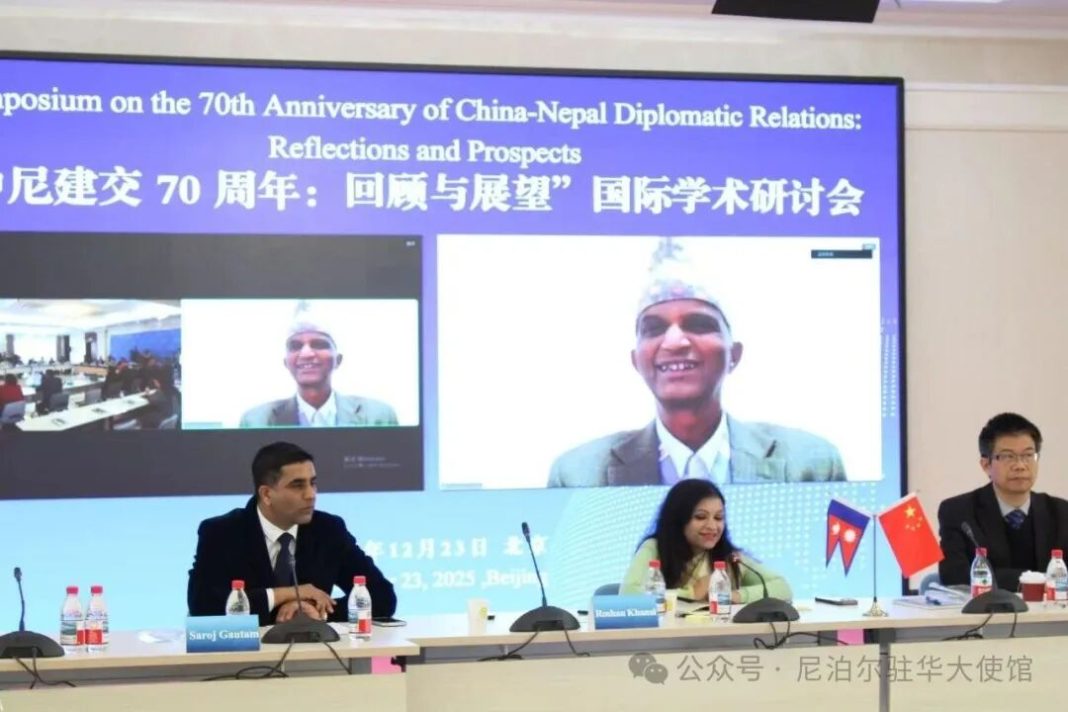

As Nepal and China commemorate the 70th anniversary of their diplomatic relations in 2025, both nations are celebrating a legacy of mutual respect, non-interference, and growing cooperation, while candidly acknowledging unmet opportunities and mapping an aspirational path forward.
Marking this historic milestone, the Embassy of Nepal in Beijing and the China Institute of International Studies (CIIS) co-hosted a high-level symposium on Tuesday, 23 December, “70th Anniversary of Nepal-China Diplomatic Relations: Reflections and Prospects.” The event brought together diplomats, academics, and policy experts from both countries to review seven decades of bilateral ties and explore new avenues for collaboration in the years ahead.
Speakers at the symposium unanimously affirmed that Nepal-China relations have remained stable, respectful, and trouble-free since formal diplomatic ties were established in 1955. CIIS Vice President Liu Qing emphasized that the “Five Principles of Peaceful ””Coexistence”—mutual respect for sovereignty and territorial integrity, mutual non-aggression, non-interference in internal affairs, equality and mutual benefit, and peaceful coexistence—have served as the bedrock of this enduring friendship.

Acting Nepali Ambassador Roshan Khanal reaffirmed Nepal’s unwavering adherence to the One-China principle and hailed recent high-level visits—including President Xi Jinping’s landmark 2019 visit to Kathmandu and Prime Minister KP Oli’s 2024 and 2025 visits—as catalysts that elevated the relationship to a “strategic cooperative partnership for everlasting friendship and development.”
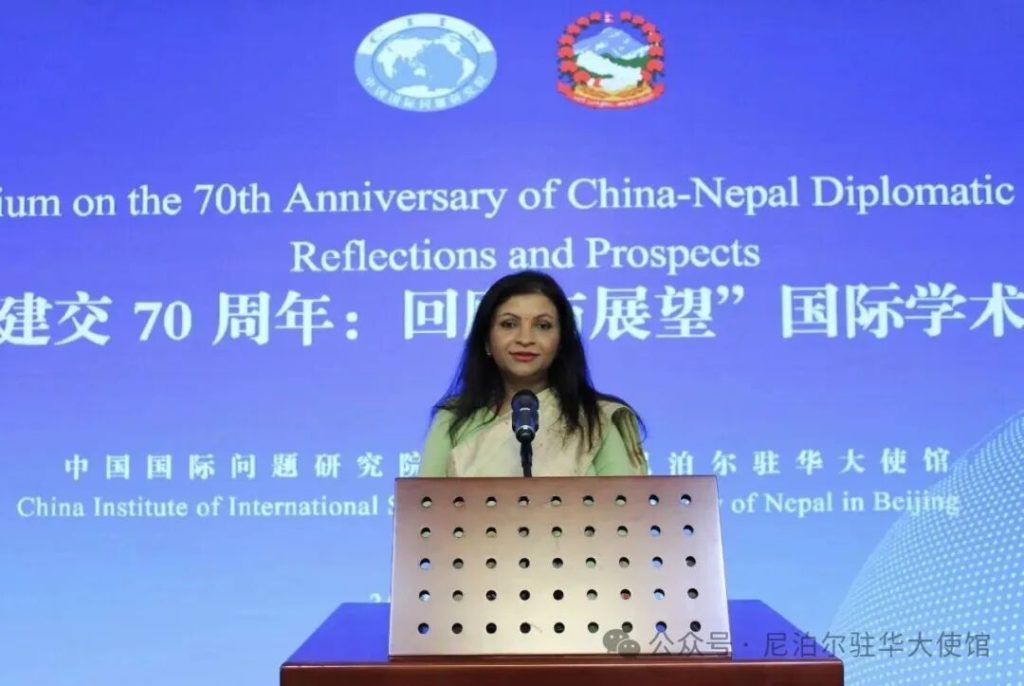
“From the legend of Manjushree to the modern-day Belt and Road Initiative, our ties are not just political—they are civilizational,” Ambassador Khanal noted, framing the bilateral bond in both historical and contemporary contexts.
While China is now Nepal’s second-largest trading partner and has granted preferential customs access for Nepali goods, experts cautioned that potential has often outpaced implementation.
Zhang Shubin, Director of the Nepal Study Center at Hebei University of Economics and Business, delivered a sobering assessment: “Many agreements have been signed, but few have been implemented. Even if just 10 percent of those commitments were fulfilled—not 50 percent—Nepal would see transformative development.”
He recalled that in earlier decades, China provided Nepal with twice the financial assistance it gave Pakistan—a level of support, he argued, that was not fully leveraged. Professor Zhang also highlighted a lost opportunity when the Confucius Institute was established in Nepal in 2007, suggesting the country could have positioned itself as a regional diplomatic hub akin to Brussels or Geneva, given its role as host of SAARC.

Despite gaps in implementation, optimism abounded regarding future cooperation. In a dedicated session themed “Exploring New Frontiers in Nepal-China Practical Cooperation: Economy, Trade, Investment, and People-to-People Exchanges,” researcher Dr. Saroj Gautam, representing the Center for Nepal Studies at East China University of Technology, presented Nepal’s “peaceful environment and natural beauty” along with its strategic positioning between China and India, untapped potentials, and tech-friendly youth population as ideal for Chinese investment and tourism.
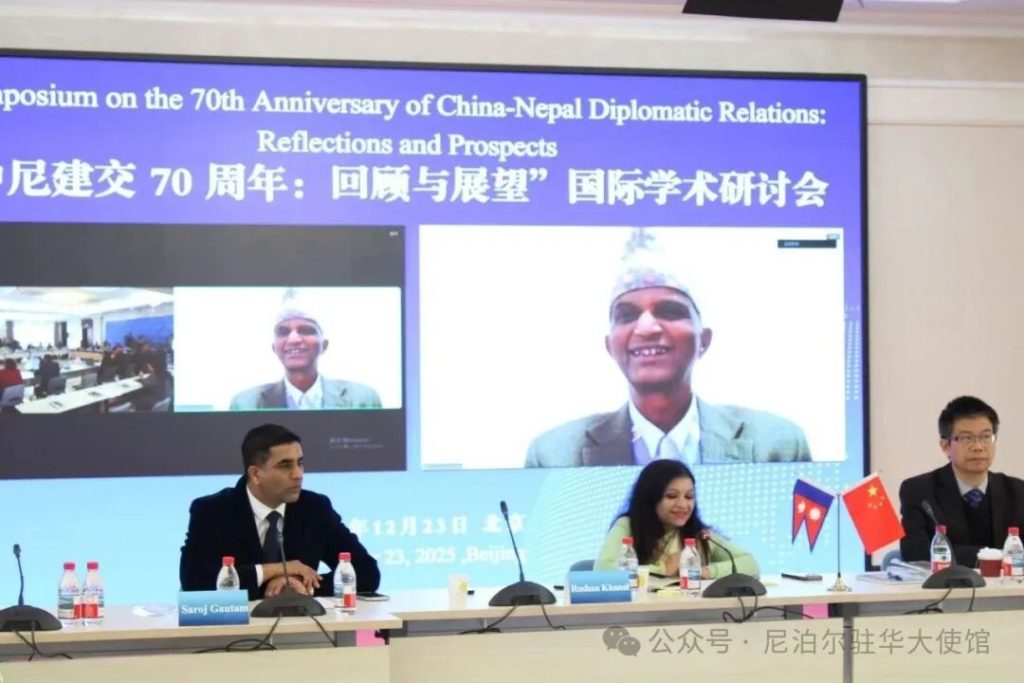
People-to-people exchanges—boosted by sister-city partnerships, Confucius classrooms, and cultural festivals—were highlighted by Dr. Gautam as key to deepening mutual understanding.
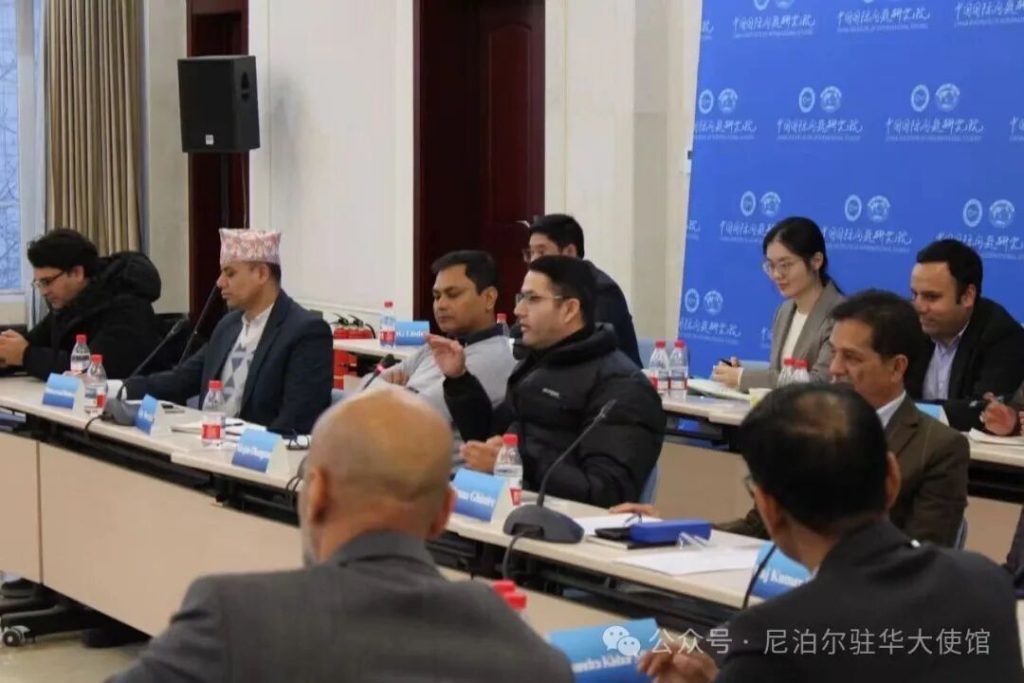
Senior CIIS Research Fellow Ms. Thang urged branding Nepal as a premier destination for Chinese travelers, a sector with vast untapped potential. Similarly, Yang Xiaoping, Associate Researcher at the Chinese Academy of Social Sciences, proposed a forward-looking roadmap centered on hydropower, science and technology, and South-South cooperation. “Understanding Nepal’s current strategic perspective is essential to addressing its developmental needs,” she said.
Both sides agreed that the true test of the next 70 years lies in turning agreements into action. Liu Qing pointed to the proposed trans-Himalayan railway, a symbolic and literal bridge between the two nations, as a potential game-changer. “If completed,” he said, “it will transform Nepal’s connectivity and economic trajectory.”
From the Nepali side, acting Chairman of the Center for China Studies Sundarnath Bhattarai, former Nepali Ambassador to Thailand and Senior Research Fellow of the Policy Research Institute Khag Adhikari, and Rector of Tribhuvan University Khadga KC, among others, pointed out many possibilities of mutual cooperation in the future, considering the past and present of Nepal-China relations.
Acting Ambassador Khanal concluded the symposium by expressing confidence that Nepal’s upcoming general elections would usher in a stable government capable of accelerating bilateral projects in trade, energy, innovation, and technology transfer. Similarly, CIIS Vice President Liu offered a unifying vision: the joint construction of a “Nepal-China community with a shared future,” a phrase echoing Beijing’s friendly foreign policy as rooted in 70 years of quiet, consistent partnership.
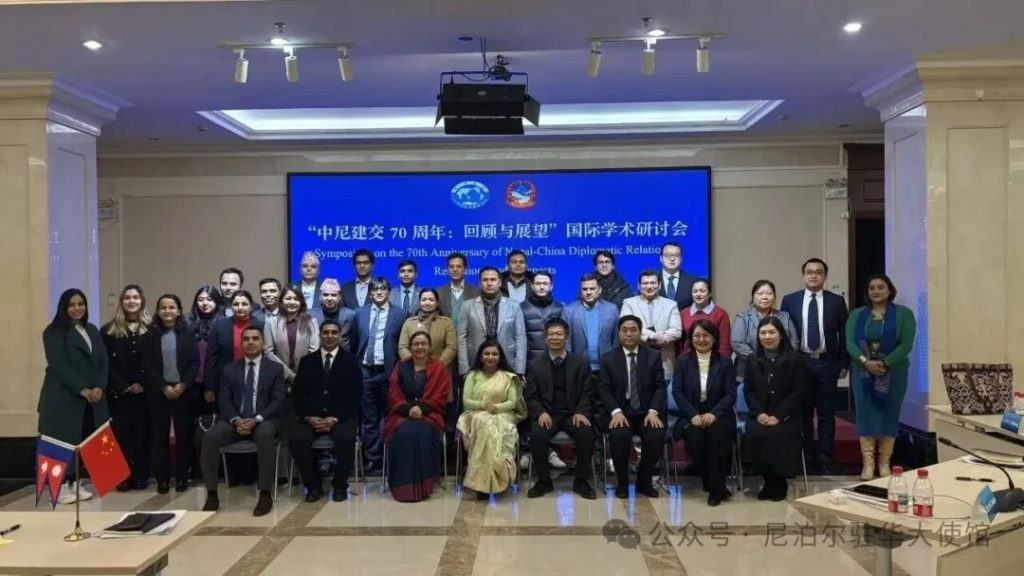
The symposium concluded with the acknowledgement that in an era of global uncertainty, the Nepal-China relationship stands as a rare example of diplomacy defined not by rivalry, but by restraint, respect, and the quiet pursuit of mutual prosperity.