
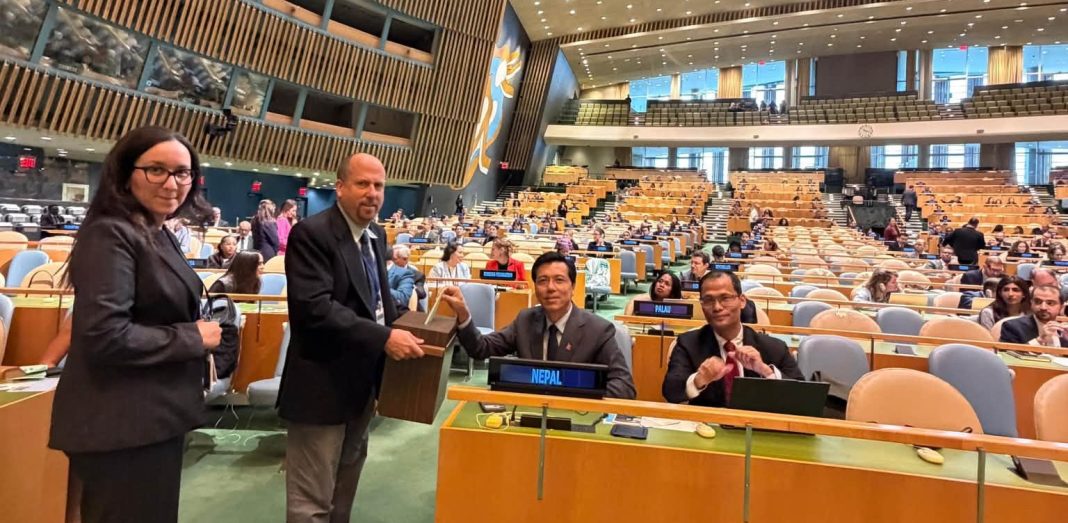

Nepal has been elected to the United Nations Human Rights Council (UNHRC) for the 2027–2029 term, securing 173 out of 180 votes in the United Nations General Assembly, according to a press statement issued by the Permanent Mission of Nepal to the United Nations in New York.
Nepal received the highest number of votes among the countries elected in its group, reflecting strong support from UN member states for its membership on the 47-member human rights body.
Nepal previously served two consecutive terms on the Human Rights Council from 2018 to 2023.
In a statement following the election, Nepal’s Permanent Mission expressed profound appreciation and gratitude to all UN member states for their trust and confidence in Nepal’s commitment to advancing multilateralism, human rights, international law and a rules-based international system with the United Nations at its core.
The mission also congratulated Brazil, Burundi, the Dominican Republic, Germany, Ghana, Ireland, Japan, Jordan, Kuwait, Moldova, Nigeria, Ukraine, Uruguay and Zambia on their election to the council for the 2027–2029 term.
Nepal said it looks forward to working closely with UN member states and other partners to safeguard human dignity, promote inclusion and social justice, and advance equitable development for all, ensuring that no one is left behind.
The Human Rights Council is the UN’s principal intergovernmental body responsible for promoting and protecting human rights around the world. Its members are elected by the General Assembly.
Conceptualizing the Knowledge and Narrative Deficit
The paper does not argue that China and Nepal lack knowledge about each other altogether. Instead, the problem is that existing knowledge is fragmented, mediated, and largely externally framed.
- Knowledge production is closely connected to power because institutions, languages, and academic systems influence whose knowledge becomes visible.
- The paper therefore emphasizes epistemic agency, or the capacity to produce and interpret knowledge from within the societies themselves.
- The proposed alternative is epistemic reciprocity, where China and Nepal produce knowledge with each other, rather than simply producing knowledge about each other.
The paper argues that stronger China-Nepal relations require not only diplomatic and physical connectivity but also knowledge connectivity.
Dipesh Chakrabarty, in “Provincializing Europe” (2000), posits that key modern social science concepts have originated within European intellectual traditions, yet are presented as universal. This notion is exemplified in the Western portrayal of countries like China, where the narrative suggests a lack of democracy, a viewpoint mirrored in Nepal, often shaped by Western discourse.
Boaventura De Sousa Santos discusses the asymmetry of knowledge in “Epistemologies of the South” (2014), suggesting that modern Western science asserts a monopoly on legitimate knowledge, thereby marginalizing alternative epistemologies.
Suresh Canagarajah, in “A Geopolitics of Academic Writing” (2002), highlights how material disparities in scholarship exacerbate center–periphery inequalities in academic publishing, revealing that scholars situated in peripheral regions contend with restricted access to essential resources such as journals, libraries, and funding. This inequity is compounded by editorial practices that tend to favor Western journals, the English language, and mainstream scholarly conventions.
Together, these scholars construct a multifaceted critique of intellectual hegemony. Chakrabarty addresses the imposition of external categories as default standards, Santos elucidates the erasure of alternative knowledge systems, and Canagarajah details how the practicalities of academic resources and publishing norms perpetuate these disparities. The discussion ultimately relates to inter-Asian relations, particularly how countries like China and Nepal engage with each other’s realities largely through mediated perspectives, underscoring the complexities of knowledge exchange in a global context.
Links the paper to Xi Jinping’s 2021 call for a Chinese discourse and narrative system, and takes up the receiving-end question of jointly produced knowledge.
Presents Nepal as an instructive case: relations since 1955, the 2016 transit agreement and the BRI since 2017.
Dipesh Chakrabarty in his Provincializing Europe (2000) argues that the concepts of modern social science (the state, citizenship, civil society, capitalism, historical time) were developed in European intellectual traditions but present themselves as universal.
The western countries try to portray that China is not a democracy, and in Nepal people think China is not democracy. The Nepali understanding comes from western narrative.
Similarly, Boaventura De Sousa Santos in his Epistemologies of the South (2014) defines the asymmetry as the result of an active process. Modern Western science and thought claim a monopoly on valid knowledge, and this has destroyed or marginalized other knowledge systems.
Suresh Canagarajah in his A Geopolitics of Academic Writing (2002) explains the asymmetry in the material conditions of scholarship to prove how centre–periphery inequality operates in academic publishing. Scholars on the periphery face limited access to journals, libraries, funding and communication technology, along with editorial gatekeeping that favours Western-based journals, English, and the genres and conventions of centre scholarship.
ogether they give a layered account. Chakrabarty explains why external categories become default, Santos explains why alternative knowledge becomes invisible, and Canagarajah explains how journals, languages and resources reproduce this in practice. The paper applies this to inter-Asian relations, where China and Nepal often learn about each other at second hand.