
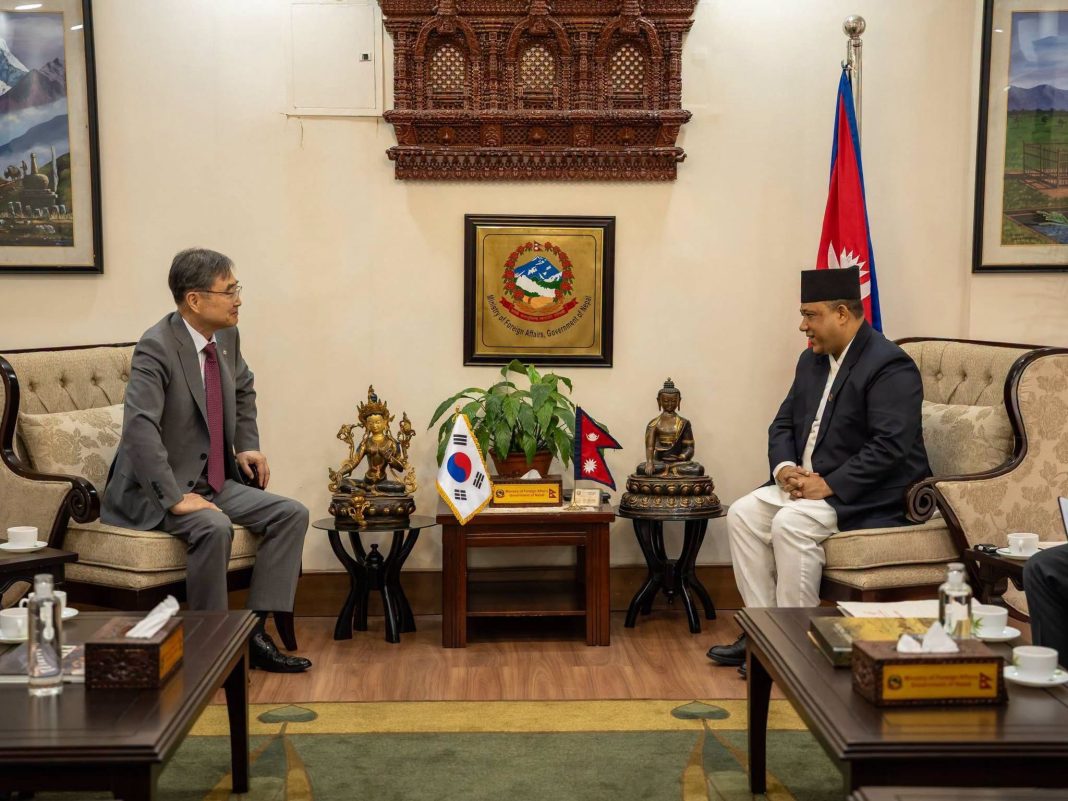

South Korea has expressed its commitment to support Nepal in its reconstruction efforts after the Bhotekoshi flood. Korea expressed this desire during a meeting between Foreign Minister Shisir Khanal and South Korean Foreign Minister Cho Hyun at the Ministry of Foreign Affairs in Singha Durbar on Sunday.
During the meeting, detailed discussions were held on the ongoing search, rescue and relief operations after the devastating flood in the Bhotekoshi River on August 26, as well as the search for missing Korean citizens, according to the Ministry of Foreign Affairs.
Minister Khanal thanked the South Korean government for sending a Korean disaster relief team and an inter-agency rapid response team to the flood-affected area, according to the Ministry of Foreign Affairs.
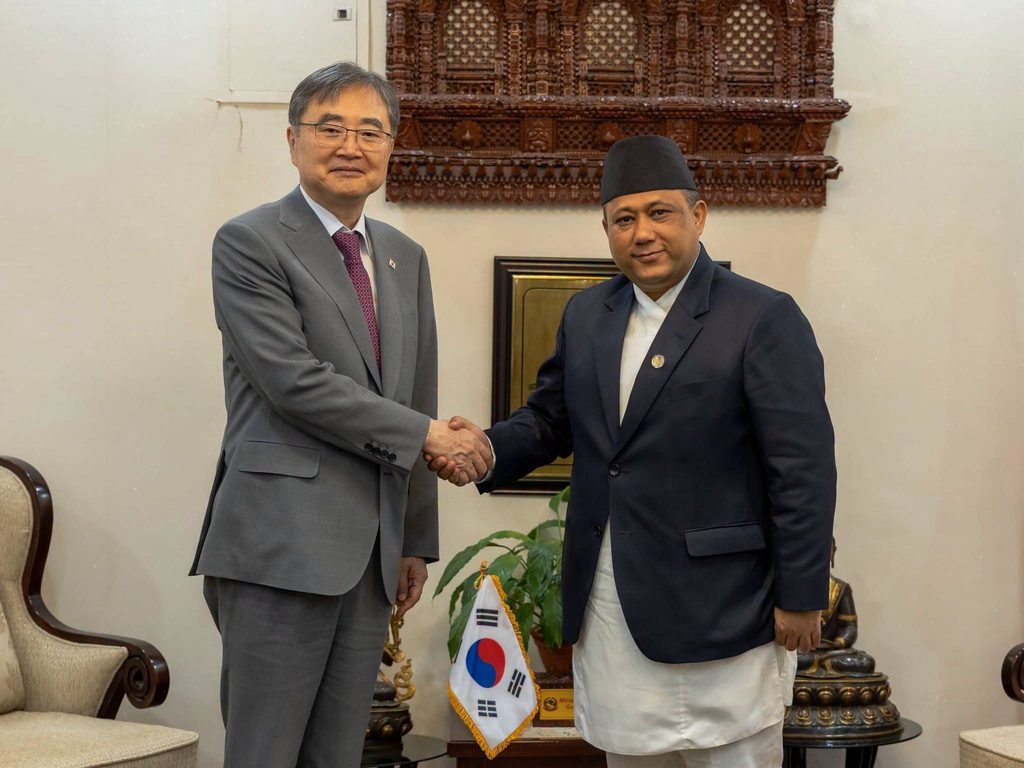
Praising the humanitarian assistance and supply of relief materials, Minister Khanal said that building disaster-resistant, sustainable and strong infrastructure is the main priority of the Nepal government in the coming days. For this, he also expressed his expectation of continued support from Korea.
South Korean Foreign Minister Cho Hyun touched down in Kathmandu on Saturday for a three-day official visit, but his agenda extends far beyond ceremonial handshakes. At its heart lies a somber quest: the search for nine South Korean nationals who vanished nearly two weeks ago, swallowed by the wrath of floodwaters and landslides that tore through Rasuwa district on August 26.
The missing men were no ordinary travelers. They were senior technical experts—engineers and supervisors—working on the 216 MW Upper Trishuli hydropower project, a flagship venture backed by a South Korean public company. The project, nearly 95 percent complete, was poised to begin test production in July 2027. Now, its future hangs in the balance, alongside the fate of its lost architects.
The visit has not been solely about disaster and loss. It has also been a reaffirmation of the deep-rooted friendship between Nepal and South Korea—a bond cultivated over decades through development cooperation, trade, and people-to-people ties. The two foreign ministers concluded their meeting with a shared commitment to elevate bilateral relations “to new heights,” built on mutual trust, long-standing friendship, and a vision for the future.
Cho’s visit comes at a pivotal moment. The Upper Trishuli project, a symbol of Korean investment and Nepali ambition, now stands as a testament to both vulnerability and resolve. The missing experts are still unaccounted for, but the search continues—driven by Nepali and Korean teams working side by side in treacherous terrain.
While the media focus has largely been on the missing nine, the broader narrative of Cho’s visit carries a quieter, more urgent message: that disasters do not respect borders, and neither should solidarity. Nepal, a country on the frontlines of climate change, is asking not for charity, but for partnership. And South Korea, through its foreign minister’s words and actions, seems to be listening.
As Cho prepares to depart on Monday, the hills of Rasuwa remain scarred, the river still swollen, and the families of the missing still waiting. But in the corridors of Singha Durbar, a different kind of current is flowing—one of cooperation, empathy, and a shared determination to turn tragedy into a turning point.
For Nepal and South Korea, the road ahead is steep. But for the first time in weeks, it feels like they are walking it together.