

Beijing Correspondent
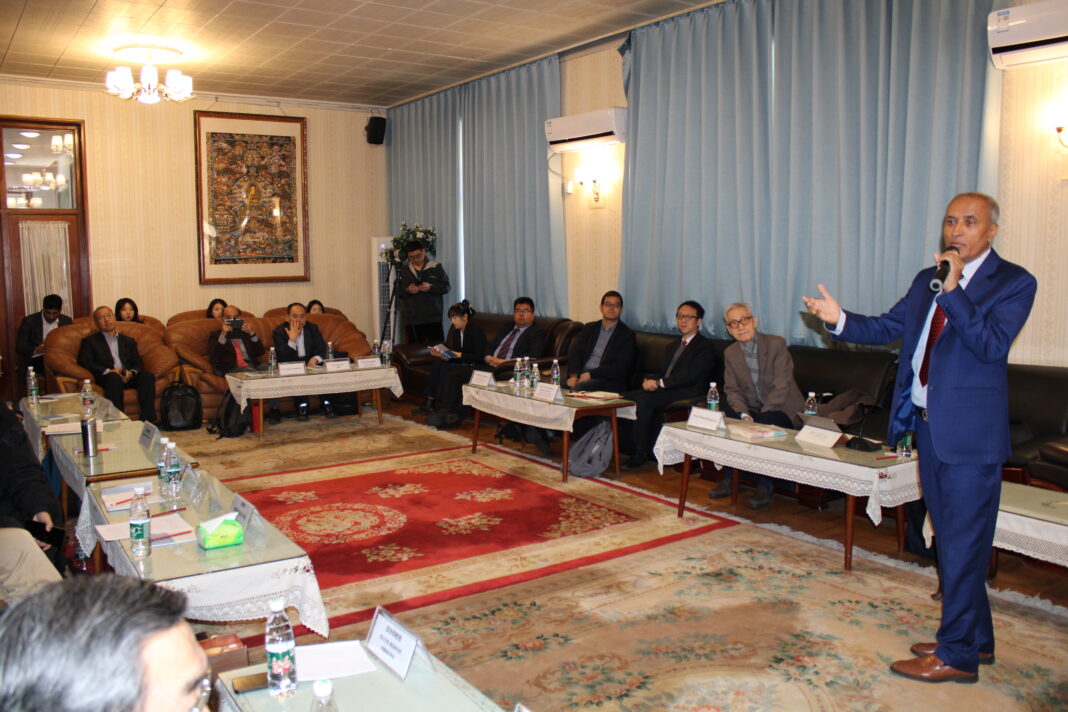
Against the backdrop of geopolitical complexity, former ambassador Leela Mani Paudyal provided an in-depth assessment of the complicated dynamics within China-Nepal relations on Friday during an insightful engagement held by the Nepali Embassy in Beijing.
Under the subject “Nepal-China Relations, Challenges, and Prospects,” former ambassador Paudyal, who is also a former Chief Secretary of the Nepal government, provided a comprehensive view of the geopolitical context in which the two nations’ relations have developed.

In highlighting the necessity of going beyond superficial narratives, Ambassador Paudyal emphasized the need for a think-tank-driven interaction strategy based on factual knowledge. He highlighted the gap that still exists between expectations and concrete results of China-Nepal agreements on various projects despite their good intentions, calling for a move toward real, fact-based conversations.
Ambassador Paudyal recognized historic accords as the upgraded Strategic Partnership in 2019 and the Transport-Transit Treaty in 2016. But he bemoaned the mismatch between outcomes and commitments, pointing to the shortcomings of programs such as the Trans-Himalayan Multi-dimensional Connectivity Network.
According to him, the 2016 Trasport-Transit Treaty sought to establish Nepal as a land-linked nation. During his October 2019 visit to Nepal, President Xi Jinping made the same pledge. With the prospect of gaining access to the world’s largest development initiative, the 2017 Belt and Road Initiative Memorandum of Understanding gave Nepal optimism and delight. The main venues for the development of mutual relations in 2018 and 2019 were the high-level visits and exchanges at the head-of-state level.
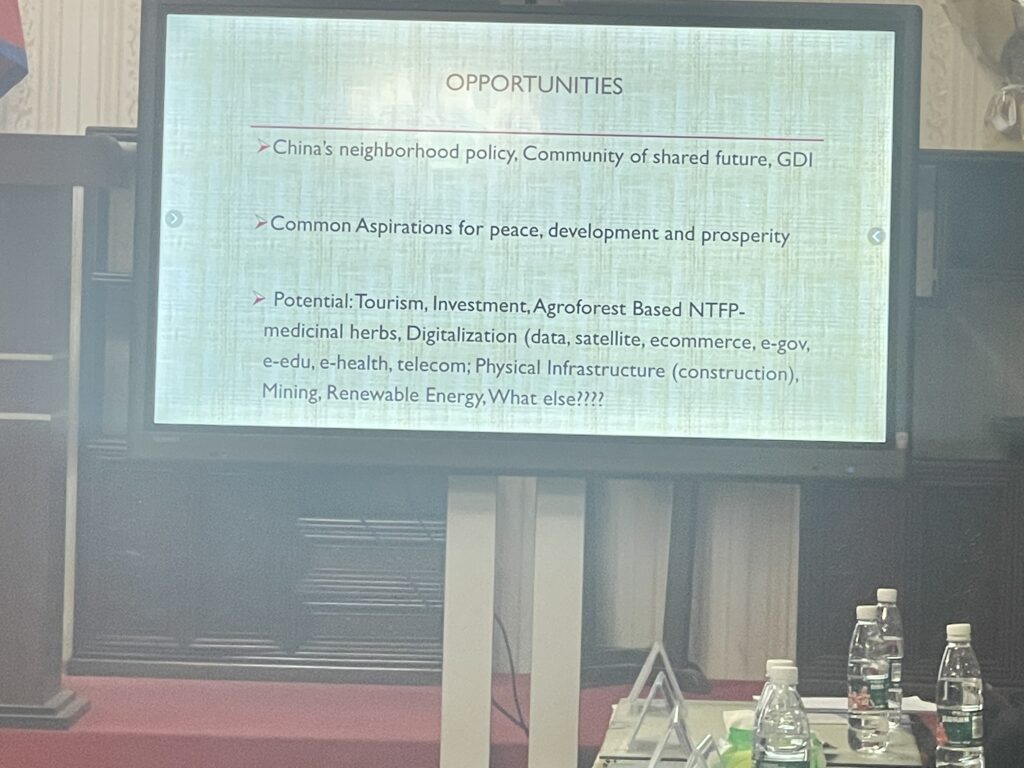
Ambassador Paudyal expressed worry about misinformation sabotaging bilateral cooperation initiatives and encouraged China to provide a prompt explanation. He argued against the use of reactive approaches and in favor of organic, knowledge-driven narratives that are based on shared potentials and strengths.
Although praising historic accords like the Transport-Transit Treaty of 2016 and the updated Strategic Partnership of 2019, Ambassador Paudyal bemoaned the absence of significant advancements, which was especially apparent in programs like the Trans-Himalayan Multi-dimensional Connectivity Network.
Ambassador Paudyal emphasized the difficulties facing the energy sector, citing India’s offers of conditional trade in electricity as a danger to Nepal’s sovereignty.
The vulnerability of Nepal is compounded by India’s obstructionist actions, which are made worse by the stagnation of power agreements and roadblocks in the air route permissions for newly built international airports in Nepal.
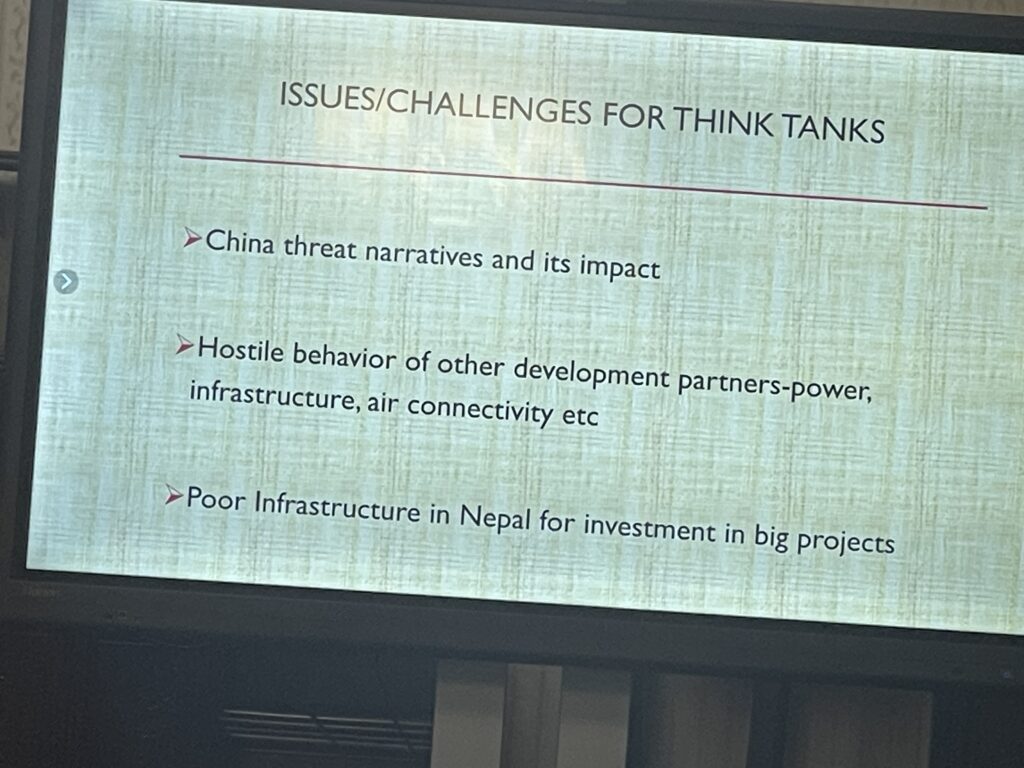
Regarding an Indian syndicate in Nepal’s hydroelectricity, Paudayal stated, “Despite agreements in 2019, the power agreement (construction of transmission lines) with China has not progressed. Delhi is now directly opposing the Chinese investments by forcing Nepal to sell its electricity only to India. Nepal, which has already gone through three Indian blockades, is growing more and more vulnerable due to its sole reliance on India for the exchange of power.”
To fully realize the potential of Sino-Nepali ties, Ambassador Paudyal urged for increased research collaboration and intellectual engagement in light of these obstacles. He highlighted the negative effects of communication gaps, providing examples of how border closures have a negative influence on bilateral trade.
According to former ambassador Paudyal, the inability to communicate in diplomacy is problematic. He cited the instance that, the post-COVID border closure issue from the Chinese side affected the Nepalese business community, and they are currently compelled to import goods from Kolkata. “This is a lose-lose scenario for trade relations between China and Nepal”, explained Paudyal.
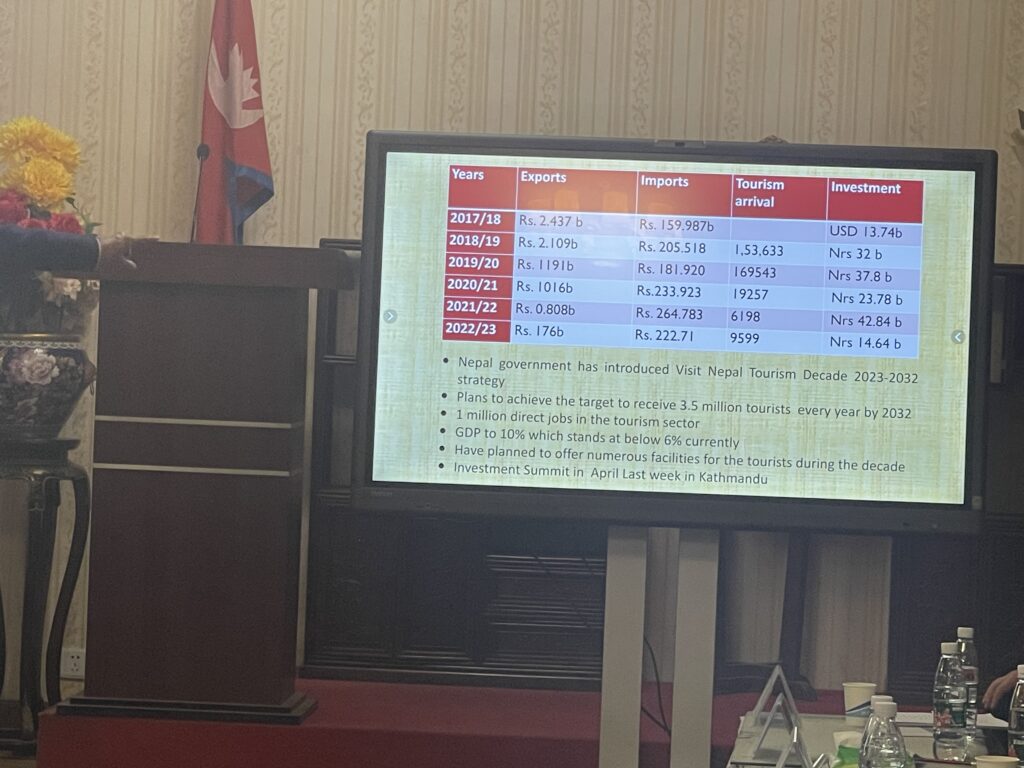
Ambassador Paudyal argued that to promote real collaboration and progress between China and Nepal, a paradigm change in favor of real, fact-based narratives is needed. He emphasized how critical it is to solve structural flaws to achieve the shared goals of the bilateral win-win collaboration.