
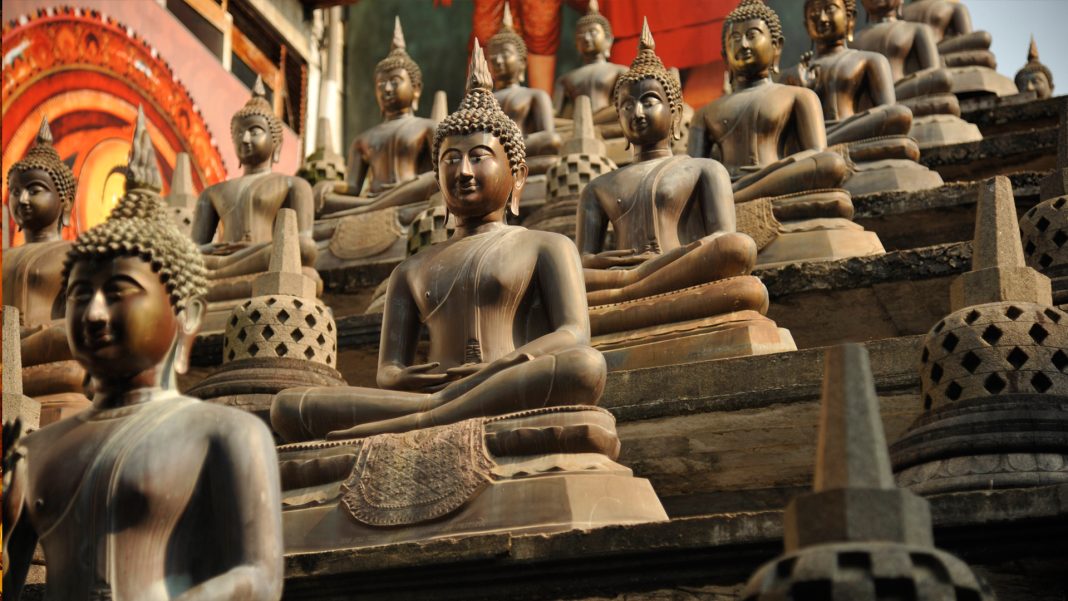

The arrival of Buddha Dhamma in Sri Lanka remains one of the most profound and enduring examples of spiritual transmission in Asian history, rooted not in conquest or coercion but in ethical vision, dialogue, and shared civilisational values. This historic journey, originating in India during the 3rd century BCE, laid the foundation for Sri Lanka’s deep and lasting Buddhist heritage and strengthened cultural bonds across the Indian Ocean world.
The turning point came during the reign of Emperor Aśoka, whose embrace of Buddha Dhamma marked a transformative era in Indian and global history. Around 250 BCE, following the Third Buddhist Council guided by the elder Moggaliputta Tissa, Aśoka initiated a series of Dhamma missions across Asia. Among these was the mission to Sri Lanka led by his son, Thera Mahinda.
Thera Mahinda’s historic meeting with King Devānampiya Tissa at Mihintale stands as a defining moment. Through the exposition of core Buddhist teachings, including the Four Noble Truths and key discourses, the king and his court embraced the Dhamma. This acceptance at the highest level of the polity ensured that Buddhism would take root not merely as a belief system but as a guiding force in governance, society, and culture.
The spread of Buddha Dhamma deepened further with the arrival of Theri Saṅghamittā, Emperor Aśoka’s daughter, who journeyed from India bearing a sapling of the sacred Bodhi Tree. Her arrival enabled the establishment of the Bhikkhunī Saṅgha and the ordination of Queen Anulā and her companions, ensuring the continuity of both monastic lineages. The planting of the Bodhi Tree and the founding of key monastic institutions anchored Sri Lanka as a major centre of Theravāda Buddhism.
Royal patronage played a decisive role in embedding Buddha Dhamma in Sri Lanka. King Devānampiya Tissa’s construction of the Thūpārāma stūpa, enshrining sacred relics of the Buddha, transformed Anurādhapura into a major spiritual centre. Over time, Sri Lanka became a beacon of Buddhist learning, attracting monks, pilgrims, and scholars from across Asia, including China and the Korean peninsula.
Sri Lanka’s contribution to the preservation of Buddha Dhamma proved invaluable. Major Dhamma gatherings held under successive rulers ensured the accurate transmission of the Tipiṭaka. Most notably, during the reign of King Vaṭṭagāmaṇī Abhaya, the Pāli Tipiṭaka was committed to writing for the first time at Alu Vihara, safeguarding the teachings at a moment when they had disappeared from much of the Indian subcontinent.
The island’s role as custodian of Theravāda orthodoxy was further strengthened in later centuries through scholarly work that shaped Buddhist thought across Asia. The translation and systematisation of commentaries into Pāli ensured their accessibility beyond linguistic and regional boundaries, reinforcing Sri Lanka’s position as a doctrinal stronghold of Buddha Dhamma.
This shared history underscores the deep spiritual and cultural connection between India and Sri Lanka. The transmission of Buddha Dhamma from India to Sri Lanka was not a one-way transfer but a civilisational partnership that preserved, enriched, and later reintroduced Buddhist teachings to the wider world.
Today, this legacy stands as a testament to India’s role as the fountainhead of Buddha Dhamma and Sri Lanka’s role as its steadfast guardian. In an era marked by geopolitical competition and cultural fragmentation, this ancient spiritual bond remains a powerful reminder of Asia’s shared ethical foundations, rooted in dialogue, restraint, and the pursuit of wisdom.